One of biology’s biggest questions is how the first living systems emerged on a planet that initially had no life. Abiogenesis is the scientific study of the possible transition from non-living chemistry to living systems.
Modern research investigates a gradual process involving organic molecules, chemical reactions, molecular organization, and early cell-like systems, but the exact pathway remains unresolved.
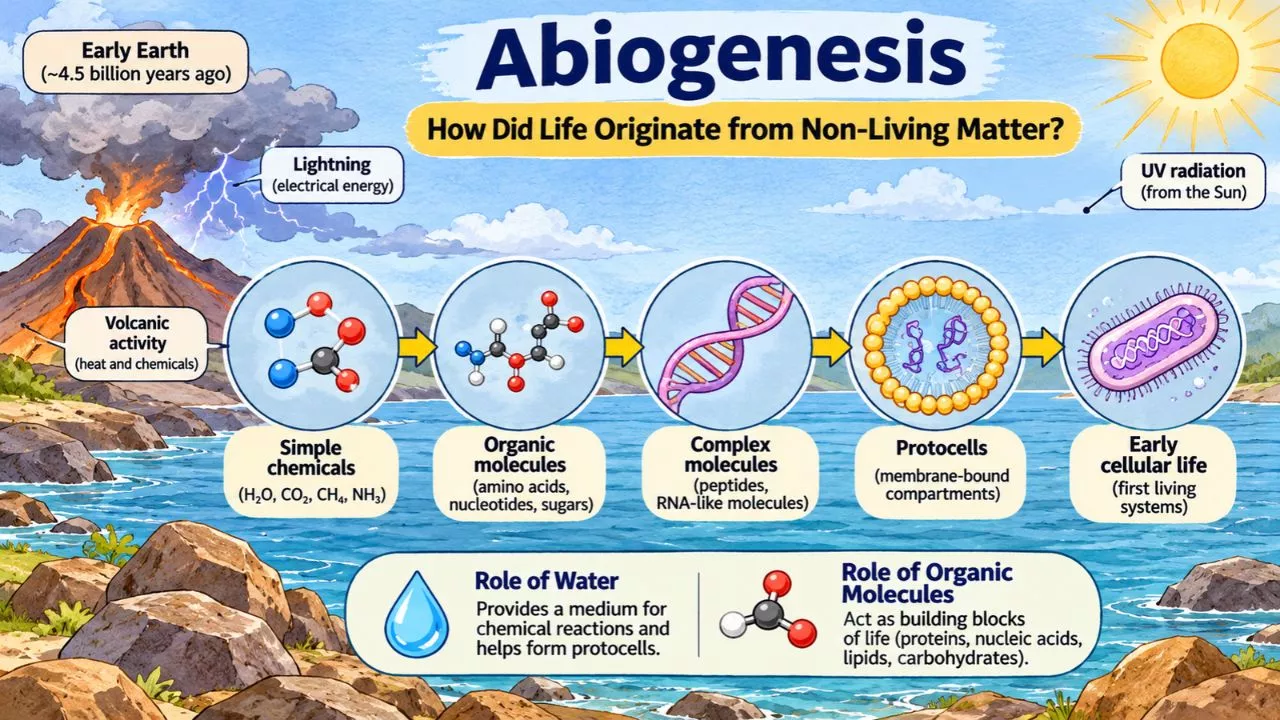
What Is Abiogenesis?
Abiogenesis refers to the natural emergence of life from non-living matter through chemical processes. The word comes from “a” (without), “bio” (life), and “genesis” (origin), so it literally means “life from non-life.”
It is important to understand that abiogenesis does not mean that modern organisms suddenly appear from lifeless objects, like maggots appearing from decaying meat.
Abiogenesis is different from biological evolution. Evolution explains how existing life changes and diversifies over time through natural selection and genetic variation.
Abiogenesis, on the other hand, investigates how the very first living systems could have come into existence from non-living chemistry.
Scientists study chemical evolution because it helps explain how simple inorganic compounds might have gradually become more complex organic molecules, and eventually, organized living systems.
Abiogenesis is a scientific research problem, not a fully reconstructed historical event. Researchers continue to investigate possible pathways, but no experiment has yet demonstrated the complete transition from non-living matter to a living cell.
How Was the Early Earth Different from Today?
The early Earth was very different from the planet we know today, and these differences are important for understanding how life might have originated.
Formation of early Earth
Earth formed approximately 4.54 billion years ago. At that time, the surface and atmosphere were very different from today’s, with intense volcanic activity, frequent meteorite impacts, and a much hotter environment.
Early atmosphere and chemical environment
The early atmosphere likely contained volcanic gases, water vapour, carbon dioxide, nitrogen, and other chemical ingredients. It is important to note that scientists do not agree on one exact atmospheric composition, and different models propose different mixtures of gases.
Sources of energy
Several possible energy sources could have driven chemical reactions on early Earth. These include lightning and electrical discharges, ultraviolet radiation from the Sun, volcanic and geothermal heat, chemical energy from reactions between minerals and fluids, and energy associated with hydrothermal systems.
When did life first appear?
Geological evidence suggests that life existed billions of years ago, but the exact date and interpretation of the oldest proposed evidence remain debated. Some studies suggest life may have emerged as early as 4.32 billion years ago, while others point to evidence from around 3.8 billion years ago.
What Are the Key Steps in Abiogenesis?
Scientists propose a simplified model of possible stages, not a confirmed chronological sequence. Each step represents a research question, not a proven event.
1. Formation of simple organic molecules
Non-living chemical ingredients could react to produce organic compounds such as amino acids, simple sugars, and nucleotide precursors. These are the basic building blocks that life uses today.
2. Formation of more complex molecules
Smaller molecular building blocks might combine into longer molecules, including peptides and nucleic-acid-like polymers. The mechanisms and conditions for these reactions remain active research questions.
3. Emergence of self-replicating molecules
Some molecules may have been able to help produce copies of themselves or catalyse reactions involved in their own reproduction. This is a key step in the transition from chemistry to biology.
4. Development of primitive metabolic networks
Interacting chemical reactions may have formed networks capable of using environmental energy and maintaining chemical organization. This is the basis of metabolism in living cells.
5. Formation of protocells
Certain lipid-like molecules can spontaneously assemble into membrane-bound structures. These compartments could concentrate chemicals and separate an internal environment from the surroundings.
6. Emergence of early cellular life
Increasingly organized systems may eventually have acquired the integrated features associated with living cells, such as metabolism, heredity, and reproduction. However, researchers have not yet demonstrated the entire sequence from simple chemicals to the first living cell.
What Is the Role of Water in Abiogenesis?
Water is considered essential in origin-of-life research for several reasons.
Water as a solvent
Water allows many chemical substances to dissolve and interact, making numerous biochemical reactions possible. This is why water is often called the “universal solvent.”
Water and chemical reactions
Water participates in many reactions, but it is not always favourable for building complex molecules. Some polymer-forming reactions require conditions that promote the removal of water, such as wet-dry cycles.
Water and protocell formation
Lipid-like molecules can form vesicles or membrane structures in aqueous environments. These structures are important for creating the compartments that early cells may have needed.
Possible environments
Scientists are investigating multiple possible settings for the origin of life, including oceans, hydrothermal vents, freshwater pools, volcanic environments, and wet-dry cycles. No single location has been established as the proven birthplace of life.
What Is the Role of Organic Molecules in Abiogenesis?
Organic molecules are carbon-containing compounds, and they are central to life because they form the basis of proteins, nucleic acids, membranes, and energy storage.
Amino acids
Amino acids are the building blocks of proteins. They can form through non-biological chemical reactions under suitable conditions.
Nucleotides
Nucleotides are the building blocks of RNA and DNA. They are essential for storing and transmitting genetic information.
Lipids
Lipid molecules can form membranes and help create compartments. These compartments are important for separating an internal environment from the surroundings.
Sugars and other carbon compounds
Sugars and other carbon compounds are important for energy-related chemistry and cellular structures.
It is important to note that finding organic molecules does not automatically mean that life existed. Organic molecules can form through non-biological chemical processes.
What Is the Evidence for Abiogenesis?
Evidence for abiogenesis comes from several sources, each demonstrating a different part of the possible pathway.
1. Miller-Urey experiment
The famous 1953 experiment simulated selected conditions proposed for early Earth and produced amino acids and other organic compounds. It demonstrated the abiotic production of some organic building blocks under the experimental conditions. It did not create life.
2. Organic molecules in meteorites
Organic compounds, including amino acids, have been detected in meteorites. This demonstrates that some organic chemistry can occur outside living organisms.
3. RNA and catalytic molecules
Ribozymes are RNA molecules capable of catalysing chemical reactions. This supports research into an RNA-based early stage of life.
4. Formation of cell-like structures
Laboratory demonstrations have shown that membrane vesicles and protocell-like compartments can form from non-living molecules. These are models, not complete living cells.
5. Geological evidence of early life
Ancient rocks, isotopic signatures, and possible microfossils provide evidence that life existed in the distant past. However, this evidence does not directly reveal how life originally formed.
In summary, these findings support individual parts of possible origin-of-life pathways, but no experiment has yet reproduced the entire transition from non-living matter to a living cell.
What Is the RNA World Hypothesis?
The RNA world hypothesis is a major idea in origin-of-life research.
What makes RNA special?
RNA can carry genetic information and, in some forms, catalyse chemical reactions. This dual function makes it a candidate for an early stage of life.
How could RNA have contributed to early life?
The hypothesis proposes that RNA-based systems may have existed before the modern DNA-RNA-protein system became established. RNA could have stored information and catalysed reactions at the same time.
Limitations of the hypothesis
Unresolved questions include how sufficient quantities of RNA building blocks formed, how RNA polymers emerged, and how copying and stability could have worked in early environments. The RNA world is a hypothesis, not a proven fact or the only possible model.
What Is the Difference Between Abiogenesis and Biogenesis?
| Feature | Abiogenesis | Biogenesis |
| What it investigates | Origin of the first life from non-living chemistry | Production of new living organisms by existing life |
| What it concerns | Transition from prebiotic chemistry to life | Reproduction and continuity of life |
| Focus | Early Earth’s conditions and chemical evolution | Observations of living organisms reproducing |
Pasteur’s experiments against spontaneous generation do not settle the separate question of the origin of the first life. Spontaneous generation claimed that complex organisms like maggots could appear directly from decaying material under ordinary conditions.
Modern abiogenesis investigates a very different question: how the earliest living systems could have emerged gradually from non-living chemistry on the early Earth.
What Are the Limitations and Unanswered Questions in Abiogenesis Research?
Several major questions remain unanswered in abiogenesis research.
- How did the first self-replicating system emerge?
- How did complex molecules become sufficiently concentrated?
- How did early metabolism become organized?
- How did genetic information become reliably copied?
- How did primitive membranes and internal chemical reactions become integrated?
Researchers are actively testing possible answers, but the exact historical pathway is not established.
Frequently Asked Questions About Abiogenesis
Q: What is abiogenesis in simple words?
Abiogenesis is the idea that life originated from non-living matter through chemical processes.
Q: What is the evidence for abiogenesis?
Evidence includes the Miller-Urey experiment, organic molecules in meteorites, ribozymes, protocell models, and geological evidence of early life.
Q: What are the key steps in abiogenesis?
The key steps are formation of simple organic molecules, formation of complex molecules, emergence of self-replicating molecules, development of metabolic networks, formation of protocells, and emergence of early cellular life.
Q: What is the role of water in abiogenesis?
Water acts as a solvent, participates in chemical reactions, and helps form protocell membranes.
Q: What is the role of organic molecules in abiogenesis?
Organic molecules like amino acids, nucleotides, lipids, and sugars are the building blocks of life and can form through non-biological chemical reactions.
Q: Did the Miller-Urey experiment create life?
No. It produced amino acids and other organic compounds under simulated early Earth conditions, but it did not create living cells.
Q: What is the RNA world hypothesis?
It is the idea that RNA-based systems may have existed before the modern DNA-RNA-protein system, with RNA serving both as genetic material and catalyst.
Q: Where might life have originated on Earth?
Possible locations include oceans, hydrothermal vents, freshwater pools, volcanic environments, and wet-dry cycles. No single location is proven.
Q: Is abiogenesis the same as evolution?
No. Abiogenesis investigates the origin of the first life, while evolution explains how existing life changes and diversifies over time.
Q: Has abiogenesis been proven experimentally?
No. Experiments have demonstrated parts of the process, but the complete transition from non-living matter to a living cell has not been reproduced.
Key Takeaways
- Abiogenesis is the natural emergence of life from non-living matter through chemical processes.
- The early Earth had different conditions, including volcanic gases, water vapour, and various energy sources.
- Key steps include formation of organic molecules, complex molecules, self-replicating systems, metabolic networks, protocells, and early cellular life.
- Water and organic molecules are central to origin-of-life research.
- Evidence includes the Miller-Urey experiment, meteorites, ribozymes, protocell models, and geological records.
- The RNA world hypothesis is a major idea, but it is not proven.
- Many questions remain unanswered, and the exact pathway is still unknown.
References
- Wikipedia, “Abiogenesis”: https://en.wikipedia.org/wiki/Abiogenesis
- Encyclopaedia Britannica, “Abiogenesis”: https://www.britannica.com/science/abiogenesis
- Institute for Creation Research, “The Myth of Abiogenesis”: https://www.icr.org/content/myth-abiogenesis