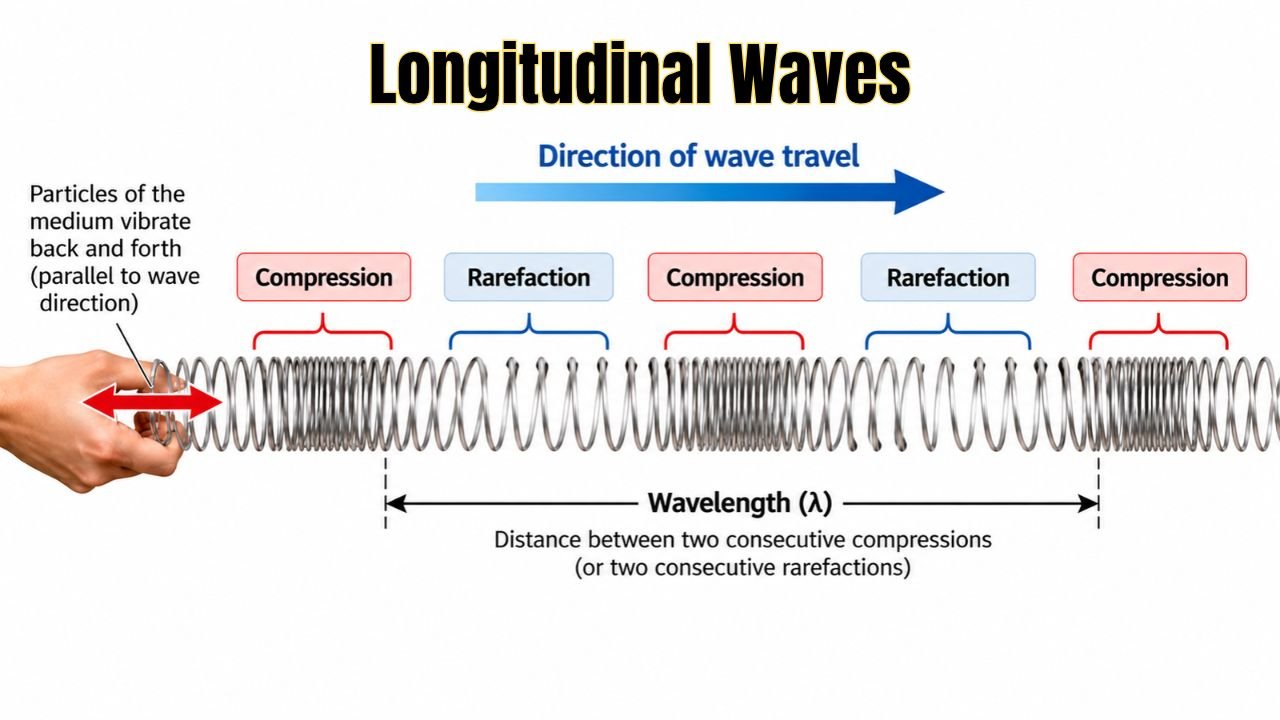
A longitudinal wave is a wave in which the particles of the medium oscillate back and forth along the same direction in which the wave travels. Sound in air is the most familiar example: the air particles vibrate parallel to the direction the sound is moving.\
What Is a Longitudinal Wave?
A longitudinal wave is a mechanical wave in which the disturbance is parallel to the direction of wave propagation. This means the particles of the medium move back and forth along the same line that the wave travels, creating regions where particles are pushed together and regions where they are spread apart.
Longitudinal waves are sometimes called compression waves or compressional waves because of these alternating regions of compression and spreading. They are mechanical waves, which means they need a medium, such as a solid, liquid, or gas, to travel through.
How Are Longitudinal Waves Generated?
Longitudinal waves are generated when a source vibrates or oscillates along the direction of wave travel, pushing and pulling the particles of the medium.
For example, when a tuning fork vibrates, it pushes and pulls the air molecules next to it. This creates a disturbance that travels outward through the air as a sound wave.
Similarly, if you push and pull one end of a stretched spring (slinky) along its length, you create a longitudinal wave that travels along the spring.
The key idea is that the source must vibrate parallel to the direction the wave will travel. This is what distinguishes the generation of a longitudinal wave from that of a transverse wave, where the source vibrates perpendicular to the direction of travel.
Compressions and Rarefactions in Longitudinal Waves
As a longitudinal wave travels through a medium, it creates two alternating regions.
A compression is a region where the particles are pushed close together, making the density and pressure higher than normal. A rarefaction is a region where the particles are spread apart, making the density and pressure lower than normal.
These compressions and rarefactions travel through the medium together, carrying the wave’s energy. In a sound wave, compressions correspond to slightly higher air pressure and rarefactions to slightly lower air pressure. This is why sound waves are often described as pressure waves.
What Are the Characteristics of Longitudinal Waves?
Longitudinal waves have several key characteristics that describe their behaviour.
1. Parallel Particle Motion
The defining feature of a longitudinal wave is that the back-and-forth movement of the medium’s particles is in the exact same line as the propagation of the wave.
Compare this with a transverse wave, like a wave on a rope that you shake up and down. In that case, the rope particles move perpendicular to the direction the wave travels.
In a longitudinal wave, if the wave travels from left to right, the particles also move left and right, oscillating about their rest positions.
A simple way to see this is with a slinky. If you push and pull one end along the length of the spring, you will see bunches of coils moving along the spring in the same direction as your push.
Each coil only moves a small distance back and forth, but the disturbance travels the whole length of the spring.
2. Compressions and Rarefactions
As the wave travels, it creates two alternating types of regions in the medium.
A compression is a region where particles are squeezed or bunched together. Because the particles are crowded, the pressure and density in this region are higher than normal.
A rarefaction is a region where particles are spread or pulled apart. Because the particles are farther apart, the pressure and density in this region are lower than normal.
These two regions alternate along the wave and travel together through the medium. In a sound wave, a compression is a moment of slightly higher air pressure, and a rarefaction is a moment of slightly lower air pressure.
This is why sound waves are also called pressure waves. If you place a detector at a fixed point, it will record pressure rising at each compression and falling at each rarefaction, in a regularly repeating pattern.
Think of compressions and rarefactions as the longitudinal-wave equivalents of crests and troughs in a transverse wave. A transverse wave has high points and low points; a longitudinal wave has crowded points and spread-out points.
3. Wavelength (λ)
The wavelength, denoted by the Greek letter lambda (λ), is the distance between two consecutive points of identical phase on the wave.
In a longitudinal wave, this is most easily measured as the distance from the center of one compression to the center of the next compression, or from the center of one rarefaction to the center of the next rarefaction. Both give the same value, because the pattern repeats once every cycle.
Since longitudinal waves have no crests or troughs, you cannot measure wavelength the way you would on a water wave. Instead, you measure the length of one complete repeating pattern of compression plus rarefaction.
4. Amplitude
The amplitude of a longitudinal wave is the maximum displacement of a particle from its rest (equilibrium) position.
In a sound wave, amplitude also relates to the pressure variation of the wave. A larger amplitude means bigger pressure changes between compressions and rarefactions, which we experience as a louder sound.
A smaller amplitude means smaller pressure changes, which we experience as a softer sound.
It is worth remembering that amplitude describes the energy of the wave, not its speed. Changing the amplitude changes how intense the wave is, but not how fast it travels.
5. No Polarization
Longitudinal waves cannot be polarized. Polarization is the process of restricting the vibrations of a wave to a single plane, and it only works for transverse waves, where vibrations are perpendicular to the direction of travel.
Because longitudinal waves vibrate along the same axis as the wave movement, there is no perpendicular vibration to filter out.
This is a useful distinguishing point for exams: if a question asks which waves can be polarized, the answer is transverse waves, not longitudinal waves.
6. Requirement for a Medium
Longitudinal waves are mechanical waves, so they require a physical medium, whether solid, liquid, or gas, to transfer energy. They cannot travel through a vacuum.
The medium does two jobs. First, its particles provide something that can oscillate. Second, the bonds or interactions between particles allow the disturbance to be passed along from one particle to the next. Remove the medium, and there is nothing to vibrate, so the wave cannot exist.
7. Speed Across Media
The speed of a longitudinal wave depends on the elasticity and density of the medium. A stiffer medium passes the disturbance along faster, while a denser medium tends to slow it down. The general relationship for a longitudinal wave in a fluid is:

where  is the bulk modulus (a measure of the medium’s resistance to compression) and
 is its density.
This explains a useful pattern: sound travels fastest in solids, slower in liquids, and slowest in gases. Solids are much stiffer than liquids and gases, and this higher elasticity more than compensates for their greater density.
For example, sound travels at roughly 340 m/s in air, about 1,480 m/s in water, and around 5,000 m/s in steel.
What Is the Wavelength of a Longitudinal Wave?
The wavelength, represented by the Greek letter lambda (\lambda), is the distance between two adjacent identical points of the wave, measured parallel to the direction of propagation.
In a longitudinal wave, the wavelength can be measured as the distance from the start of one compression to the start of the next compression, or from the start of one rarefaction to the start of the next rarefaction. It is measured in metres (m).
What Is the Frequency of a Longitudinal Wave?
The frequency, represented by f (or the Greek letter \nu, nu), is the number of complete wave cycles that pass a fixed point in one second.
Frequency is measured in hertz (Hz), where 1 Hz means one cycle per second. The frequency of a wave is determined by the source that generates it. The time for one complete cycle is called the period T, and frequency is related to the period by:
For example, if a wave has a period of 0.01 seconds, its frequency is 100 Hz.
What Is the Amplitude of a Longitudinal Wave?
The amplitude of a longitudinal wave is the maximum displacement of a particle from its equilibrium (resting) position.
In a longitudinal wave, amplitude can also be described in terms of the maximum change in pressure or density compared with the normal state of the medium.
A larger amplitude means the compressions are denser and the rarefactions are less dense, which corresponds to a louder sound in the case of a sound wave.
Importantly, amplitude is independent of the wave speed. It depends on the energy carried by the wave, not on how fast the wave travels.
Longitudinal Wave Formula and Wave Speed
The wave speed is the distance the wave travels in a given time. For all progressive waves, including longitudinal waves, the relationship between speed, frequency, and wavelength is:
Where:
| Symbol | Meaning | SI unit |
| v | Wave speed | metre per second (m/s) |
| f | Frequency | hertz (Hz) |
| λ | Wavelength | metre (m) |
This can also be written as:
For longitudinal waves in a medium, the speed also depends on the elastic and inertial properties of the medium. The general formula is:
Where B is the bulk modulus of the medium and \rho is its density. For a longitudinal wave in a solid bar, where lateral expansion is negligible, the bulk modulus B is replaced by Young’s modulus Y, giving:
Worked example: A sound wave in air has a frequency of 340 Hz and travels at 340 m/s. Find its wavelength.
Answer: The wavelength is 1 metre.
Examples of Longitudinal Waves
Several common waves are longitudinal.
- Sound waves in air, water, and other fluids are the most familiar example. They travel as alternating compressions and rarefactions of pressure. Fluids have almost no shear strength, so sound waves in them must be longitudinal.
- Waves on a stretched spring (slinky), when you push and pull one end along its length, are longitudinal. This is a common classroom demonstration.
- Ultrasound waves used in medical imaging are high-frequency sound waves, and they are also longitudinal.
- P-waves (primary waves) in earthquakes are longitudinal waves that travel through the Earth’s interior, including through liquids.
In solids, sound can travel as both longitudinal and transverse waves, because solids have shear strength. But in liquids and gases, sound waves are longitudinal.
Difference Between Longitudinal and Transverse Waves
The main difference between longitudinal and transverse waves is the direction in which the particles of the medium oscillate.
| Feature | Longitudinal wave | Transverse wave |
| Particle oscillation | Parallel to the direction of wave travel | Perpendicular to the direction of wave travel |
| Wave structure | Alternating compressions and rarefactions | Alternating crests and troughs |
| Medium requirement | Can travel through solids, liquids, and gases | Requires a medium with shear strength, so mainly solids and strings (not ordinary fluids) |
| Examples | Sound in air, ultrasound, P-waves | Waves on a string, light waves (electromagnetic, not mechanical) |
| Can travel through vacuum? | No (mechanical wave) | Mechanical transverse waves cannot; electromagnetic waves can |
For example, when a wave travels along a rope that you shake up and down, the rope particles move perpendicular to the wave direction, so it is a transverse wave. But when you push and pull a slinky along its length, the coils move parallel to the wave direction, so it is a longitudinal wave.
Frequently Asked Questions About Longitudinal Waves
What is a longitudinal wave in simple words?
A longitudinal wave is a wave where the particles of the medium vibrate back and forth in the same direction the wave travels, creating regions of compression and spreading.
What are the main characteristics of longitudinal waves?
The main characteristics are: particles oscillate parallel to wave travel, the wave consists of compressions and rarefactions, it needs a material medium, and it is described by wavelength, frequency, amplitude, and speed.
What is the frequency of a longitudinal wave?
Frequency is the number of complete wave cycles passing a fixed point per second, measured in hertz (Hz). It is set by the vibrating source.
What is the wavelength of a longitudinal wave?
Wavelength is the distance between two adjacent identical points of the wave, such as from one compression to the next, measured in metres.
How are longitudinal waves generated?
They are generated when a source vibrates along the direction of wave travel, pushing and pulling the particles of the medium, as in a vibrating tuning fork creating sound.
What is the amplitude of a longitudinal wave?
Amplitude is the maximum displacement of a particle from its equilibrium position, or equivalently the maximum pressure or density change in the wave.
Can longitudinal waves travel through a vacuum?
No. Longitudinal waves are mechanical waves, so they need a material medium to travel through. This is why sound cannot travel through the vacuum of space.
What is the difference between compression and rarefaction?
A compression is a region where particles are pushed close together, with higher density and pressure. A rarefaction is a region where particles are spread apart, with lower density and pressure.
Are sound waves longitudinal?
Yes. Sound waves in air and most fluids are longitudinal, travelling as pressure compressions and rarefactions. In solids, sound can be both longitudinal and transverse.
Key Takeaways
- A longitudinal wave is a wave where particles oscillate parallel to the direction of wave travel.
- It consists of alternating compressions (high density and pressure) and rarefactions (low density and pressure).
- It is a mechanical wave, so it cannot travel through a vacuum.
- Wavelength is the distance from one compression to the next; frequency is cycles per second in hertz; amplitude is the maximum particle displacement.
- Sound in air is the most familiar example of a longitudinal wave.
- Unlike transverse waves, longitudinal waves do not form crests and troughs.
Reference
- NCERT Physics, Chapter 14, “Waves”: https://ncert.nic.in/textbook/pdf/keph207.pdf
- OpenStax Physics, “Types of Waves”: https://openstax.org/books/physics/pages/13-1-types-of-waves
- OpenStax Physics, “Wave Properties: Speed, Amplitude, Frequency, and Period”: https://openstax.org/books/physics/pages/13-2-wave-properties-speed-amplitude-frequency-and-period
- OpenStax University Physics Volume 1, “Traveling Waves”: https://openstax.org/books/university-physics-volume-1/pages/16-1-traveling-waves
- OpenStax University Physics Volume 1, “Sound Waves”: https://openstax.org/books/university-physics-volume-1/pages/17-1-sound-waves
- ORISE Lesson Plan, “The Power of Waves”: https://orise.orau.gov/K12/documents/lesson-plans/the-power-of-waves-final-version.pdf