When you heat water in a saucepan, you can see it circulate, and when you stand near a heater, you feel warm air rising. Both of these are examples of convection, the transfer of heat through the bulk movement of a fluid.
Fluids include both liquids and gases, so convection happens in water, air, and many other substances.
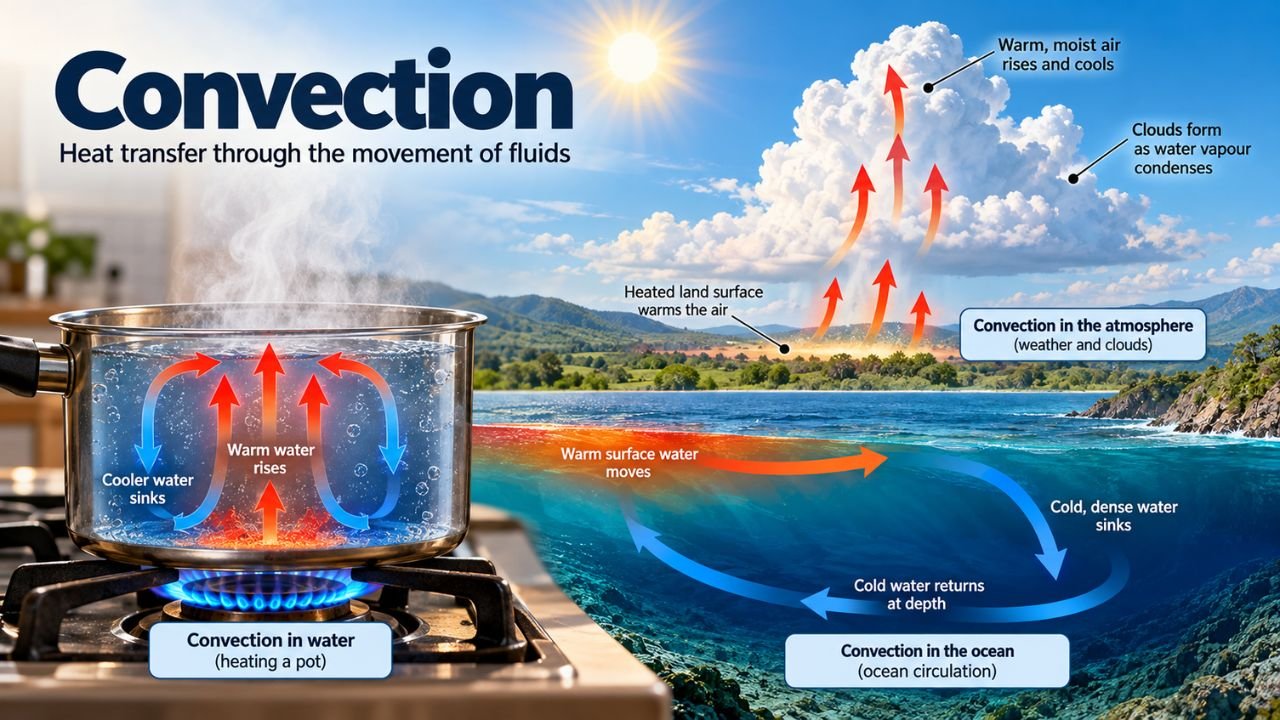
What Is Convection?
Convection is the process by which heat is transferred through the movement of a fluid, such as a liquid or a gas. When part of a fluid is heated, it can move and carry thermal energy with it to another part of the system.
A fluid is any substance that can flow, which includes liquids like water and gases like air. Unlike solids, fluids can move in bulk, and this movement is what makes convection possible.
Convection is one of three main ways heat can be transferred, alongside conduction and radiation. Conduction transfers heat through direct contact between particles without bulk movement, while radiation transfers heat through electromagnetic waves. Convection is different because it requires the fluid itself to move.
How Does Convection Work?
Convection works through a sequence of steps involving heat, density, and buoyancy.
First, a heat source warms a region of the fluid. For example, the bottom of a saucepan heats the water directly above it. As the water warms, it expands and becomes less dense than the cooler water around it.
Because it is less dense, buoyancy causes it to rise. Cooler, denser fluid then moves in to take its place, and this creates a continuous circulation called a convection current.
This cycle of warm fluid rising and cool fluid sinking is what transports thermal energy through the fluid. The movement continues as long as there is a temperature difference driving it.
The actual behaviour depends on conditions like the temperature distribution, the properties of the fluid, and whether a fan or pump is forcing the flow.
It is important to understand that it is not the heat itself that rises, but the warmer, less dense fluid. The moving fluid carries the thermal energy with it. Also, warm fluid does not always rise; the direction of motion depends on density differences, gravity, and the specific flow setup.
What Are the Different Types of Convection?
Convection is classified into two main types based on what causes the fluid to move.
1. Natural Convection
Natural convection, also called free convection, happens when fluid motion is driven by buoyancy resulting from density differences.
When part of a fluid is heated, it becomes less dense and rises, while cooler, denser fluid sinks. This creates a natural circulation without any external help.
Examples include warm air rising near a room heater and water circulating in a pot heated from below. In both cases, the temperature difference alone is enough to drive the fluid movement.
2. Forced Convection
Forced convection happens when a fan, pump, or other external mechanism drives the fluid flow. Instead of relying on buoyancy, an outside force pushes the fluid through the system.
Examples include a fan blowing air over a hot surface, coolant being pumped through a car radiator, or air being circulated in a fan-assisted oven. In these cases, the fluid moves because of the external device, not just because of temperature differences.
Comparison of natural and forced convection
| Feature | Natural convection | Forced convection |
| Driving mechanism | Buoyancy from density differences | Fan, pump, or other external device |
| Fluid movement cause | Temperature difference within the fluid | External force applied to the fluid |
| Example | Warm air rising near a heater | Air blown by a fan over a hot surface |
| Control | Harder to control directly | Easier to control by adjusting the fan or pump |
In real systems, both natural and forced convection can occur at the same time. This is called mixed convection.
Examples of Convection in Everyday Life
Convection is happening all around us, often without us noticing.
Water circulating as it heats in a saucepan is a classic example. The fluid is water, the heat source is the stove, and the warmer water at the bottom rises while cooler water sinks, creating a convection current.
Warm air rising near a room heater is another example. The fluid is air, the heat source is the heater, and the warm air rises because it is less dense than the cooler air around it.
Sea and land breezes are caused by differential heating. During the day, land heats faster than water, so air above the land rises and cooler air from the sea moves in to replace it, creating a sea breeze.
At night, the process reverses, creating a land breeze. The fluid is air, and the heat source is the sun heating the land and water at different rates.
Hot-air balloons rise because the air inside the balloon is heated and becomes less dense than the surrounding air. The fluid is air, the heat source is the burner, and buoyancy causes the balloon to rise.
Fan-assisted ovens circulate heated air using a fan. The fluid is air, the heat source is the oven’s heating element, and the fan forces the air to move, cooking food more evenly.
Cooling systems in cars and computers move heat away from engines or electronic components. In a car radiator, coolant carries heat from the engine to the radiator, where a fan helps transfer the heat to the surrounding air. The fluid is coolant, the heat source is the engine, and a pump forces the coolant to circulate.
What Is the Role of Convection in Weather?
Convection plays a major role in shaping weather, from gentle breezes to powerful storms.
How the Sun heats the ground and air
The sun heats the Earth’s surface, and the surface transfers heat to the air directly above it. This warm air becomes less dense and begins to rise.
Cloud formation
As warm air rises, it expands because the atmospheric pressure decreases at higher altitudes. This expansion causes the air to cool. If it cools enough to reach saturation, water vapour condenses into tiny droplets or ice crystals, forming clouds.
Thunderstorms
In an unstable atmosphere with enough moisture and lifting, strong updrafts can build towering storm clouds called cumulonimbus clouds.
As water vapour condenses, it releases latent heat, which warms the surrounding air and strengthens the buoyancy, making the updrafts even stronger. This can lead to heavy rain, lightning, thunder, and sometimes hail.
Sea breezes
Land and water heat at different rates, creating temperature and pressure differences that drive local circulation.
During the day, air over the warmer land rises, and cooler air from the sea moves in, creating a sea breeze. At night, the land cools faster, and the circulation reverses, creating a land breeze.
What Is the Role of Convection in the Ocean?
Convection also plays an important role in the ocean, helping to distribute heat and move water around the globe.
Both temperature and salinity affect seawater density. Cooler water is denser than warmer water, and saltier water is denser than fresher water. In some regions, cooling and increased salinity make the water dense enough to sink.
When surface water becomes dense enough, it sinks in a process called downwelling. This sinking water feeds into deep ocean currents that flow toward the equator, while warmer surface water moves toward the poles. This creates a large-scale circulation often called the global conveyor belt.
Ocean circulation helps transport heat from the equator toward the poles, which reduces extreme temperature differences around the planet. However, ocean circulation is not caused by convection alone. Winds, Earth’s rotation, and other processes also play important roles.
What Are the Applications of Convection in Engineering?
Engineers use the principles of convection to design systems that manage heat effectively.
Heat exchangers transfer heat between fluids in separate flow paths without mixing them. Vehicle radiators use coolant to carry heat from the engine to the radiator, where a fan helps transfer the heat to the surrounding air.
Heating, ventilation, and air conditioning (HVAC) systems use fans and blowers to distribute conditioned air throughout buildings.
Electronics cooling uses fans and liquid cooling loops to remove heat from components. Power plants and industrial processes use fluid movement to support heating, cooling, boiling, and condensation.
Engineers control fluid flow, temperature differences, surface area, and equipment design to manage how much heat is transferred and how quickly.
How Is Convection Different From Conduction and Radiation?
Convection, conduction, and radiation are the three main ways heat can be transferred.
| Mechanism | How heat is transferred | Requires fluid movement? | Example |
| Conduction | Through direct contact between particles | No | Heat passing through a metal spoon |
| Convection | Through bulk movement of a fluid | Yes | Water circulating in a heated pot |
| Radiation | Through electromagnetic waves | No | Heat from the sun reaching Earth |
When you heat a pot on a stove, all three mechanisms can be at work. Energy passes through the pot by conduction, circulates within the water by convection, and can also be transferred by radiation from the flame or heating element.
A Simple Numerical Example of Convective Heat Transfer
For students ready for the equation, the rate of convective heat transfer can be calculated using:
Where:
- Q = heat-transfer rate (watts, W)
- h = convective heat-transfer coefficient (W/m²·K)
- A = surface area (m²)
- Ts = surface temperature (°C or K)
- Tf = representative fluid temperature (°C or K)
Worked example: A surface with an area of 0.5 m² is at 80°C, and the surrounding air is at 25°C. If the convective heat-transfer coefficient is 10 W/m²·K, find the heat-transfer rate.
Answer: The heat-transfer rate is 275 watts.
Note that the value of h depends on the flow conditions and the properties of the fluid. This equation is a useful engineering model, but it does not describe every detail of a convection process.
Frequently Asked Questions About Convection
Q: What is convection in simple words?
Convection is the transfer of heat through the movement of a fluid, such as air or water.
Q: How does convection work?
A heat source warms part of a fluid, making it less dense. Buoyancy causes it to rise, while cooler, denser fluid sinks, creating a circulation called a convection current.
Q: What is a convection current?
A convection current is a continuous circulation pattern where warm fluid rises and cool fluid sinks, transferring heat through the fluid.
Q: What is the difference between natural and forced convection?
Natural convection is driven by buoyancy from density differences. Forced convection is driven by an external device like a fan or pump.
Q: Can convection occur in solids?
No. In the usual school-level classification, convection requires bulk fluid movement, which solids cannot do. Heat in solids is transferred mainly by conduction.
Q: Why does warm air rise?
Warm air expands and becomes less dense than the cooler air around it. Buoyancy causes the less dense air to rise.
Q: How does convection help form clouds?
Warm air rises, expands, and cools. If it cools enough to reach saturation, water vapour condenses into droplets, forming clouds.
Q: How does convection affect ocean currents?
Temperature and salinity differences make some seawater dense enough to sink, driving large-scale circulation that transports heat around the globe. Winds and Earth’s rotation also play important roles.
Q: What are five examples of convection?
Water circulating in a heated pot, warm air rising near a heater, sea breezes, hot-air balloons, and fan-assisted ovens.
Q: What is the difference between convection and conduction?
Convection transfers heat through the bulk movement of a fluid. Conduction transfers heat through direct contact between particles without bulk movement.
Key Takeaways
- Convection is heat transfer through the bulk movement of a fluid.
- It requires a fluid, such as a liquid or gas.
- Warm fluid rises and cool fluid sinks, creating convection currents.
- Natural convection is driven by buoyancy; forced convection is driven by a fan or pump.
- Convection plays a major role in weather, cloud formation, and ocean circulation.
- Engineers use convection in heat exchangers, radiators, HVAC systems, and electronics cooling.
References
- Met Office, “What role does convection play in weather?”: https://www.metoffice.gov.uk/blog/2025/what-role-does-convection-play-in-weather
- Met Office, “Convergence lines”: https://weather.metoffice.gov.uk/learn-about/weather/types-of-weather/clouds/unusual-cloud-formations/convergence-lines
- Encyclopaedia Britannica, “Convection”: https://www.britannica.com/science/convection
- Springer Nature, “Convection”: https://link.springer.com/rwe/10.1007/978-3-319-51727-8_1-1
- Autodesk, “Fluid Flow Definitions”: https://help.autodesk.com/cloudhelp/2026/ENU/SimCFD-Learning/files/GUID-4DAF0D6D-fBa5Z9uE-qkGfVYuvcYLYv10dH8Nsgcnv6pXm8X2r9Xw==.htm
- SimScale, “What Is Convection?”: https://www.simscale.com/docs/simwiki/heat-transfer-thermal-analysis/what-is-convection/
- SOLIDWORKS, “Convection”: https://help.solidworks.com/2025/English/SolidWorks/cworks/c_Convection.htm