Abiotic factors are the non-living physical and chemical components of an environment that influence where organisms can survive, grow, and reproduce.
A cactus can survive in a dry desert because it is adapted to low water and high temperatures condition, while most fish cannot live out of water because they need water to breathe and maintain their body functions.
These non-living conditions, such as sunlight, temperature, water, and soil, help decide which organisms can live in which condition.
What Are Abiotic Factors in biology?
Abiotic factors are the non-living physical and chemical parts of an ecosystem. They include things like sunlight, temperature, water, air, soil, pH, salinity, and mineral nutrients. These factors affect the survival, growth, reproduction, and distribution of living organisms.
The terms “abiotic factors” and “abiotic components” are often used to mean the same thing. They both refer to the non-living conditions in an environment that living things depend on.
Abiotic Factors vs. Biotic Factors
It is important to distinguish abiotic factors from biotic factors before looking at each one in detail.
| Feature | Abiotic factors | Biotic factors |
| Nature | Non-living | Living |
| Examples | Sunlight, water, temperature, pH | Plants, animals, fungi, bacteria |
| How they affect organisms | Through physical and chemical conditions | Through feeding, competition, disease, and other interactions |
| Role in ecosystem | Set the physical and chemical limits | Interact with and depend on abiotic conditions |
In a pond, for example, sunlight, water temperature, and dissolved oxygen are abiotic factors. Fish, algae, and bacteria are biotic factors. Both types interact: sunlight affects water temperature and algae growth, which in turn affects the fish that eat the algae.
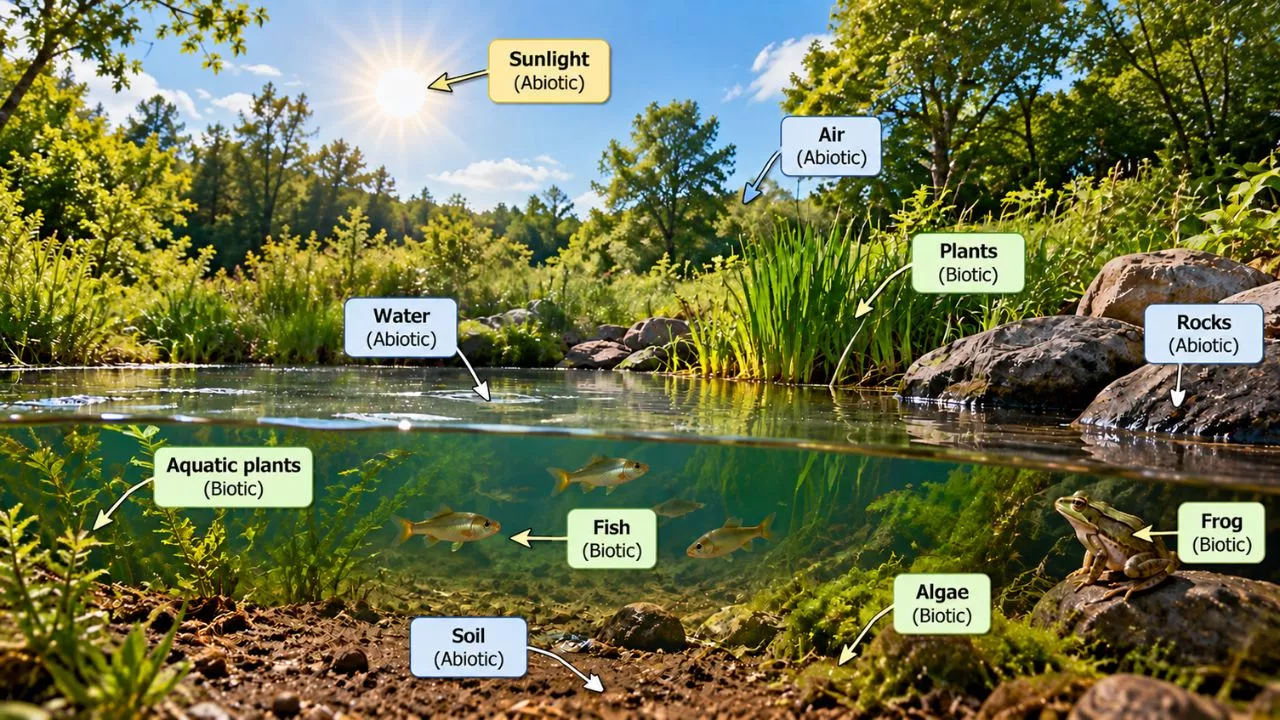
Major Types of Abiotic Factors
Abiotic factors can be grouped into physical factors (like light and temperature), chemical factors (like pH and salinity), and soil-related conditions (like moisture and nutrients). These are useful teaching categories, not a strict or universally fixed classification.
1. Sunlight
Sunlight is the main source of energy for photosynthesis, the process by which plants and other autotrophs make their own food. Without sunlight, most ecosystems would collapse because there would be no primary producers.
Sunlight also affects daily activity patterns in animals. Many animals are active during the day (diurnal) or at night (nocturnal), depending on light levels.
2. Temperature
Temperature affects enzyme activity, metabolism, and survival limits in organisms. Each species has a range of temperatures within which it can survive and function properly.
For example, coldwater fish need cool water to survive. If water gets too warm, their metabolism speeds up in ways that can harm them, and they may not get enough oxygen.
3. Water Availability
Water is essential for hydration, photosynthesis, and maintaining habitat suitability. Life on Earth originated in water, and most organisms cannot survive without it.
In deserts, low water availability limits which plants and animals can live there. In wetlands, abundant water supports a wide range of species.
4. Air and Gases
Oxygen is needed for aerobic respiration in most organisms, while carbon dioxide is needed for photosynthesis in plants. The availability of these gases affects which organisms can live in a given environment.
For example, aquatic organisms depend on dissolved oxygen in water. If oxygen levels drop too low, fish and other aquatic life can suffocate.
5. Soil
Soil provides physical support, water, and minerals for plants. Its texture, drainage, moisture, and mineral content affect root growth and which plants can grow in an area.
Soil is a mix of non-living particles and living organisms. The abiotic properties of soil, like its pH and mineral composition, strongly influence the vegetation that grows there.
6. pH
pH measures how acidic or alkaline soil or water is. Most organisms have a narrow pH range in which they can survive.
For example, many freshwater fish cannot survive in very acidic water. Soil pH also affects which nutrients are available to plants.
7. Salinity
Salinity refers to the concentration of salt in water or soil. It affects water balance in organisms and determines which species can live in a given aquatic environment.
Marine organisms are adapted to high salinity, while freshwater organisms cannot tolerate high salt levels. Estuaries, where rivers meet the sea, have changing salinity that only certain species can handle.
8. Humidity and Rainfall
Humidity is the amount of water vapor in the air, and rainfall is the amount of water that falls as precipitation. Both affect water loss in organisms and plant growth.
In dry climates, low humidity and low rainfall limit plant growth. In tropical rainforests, high humidity and frequent rainfall support dense vegetation.
9. Dissolved Oxygen
Dissolved oxygen is the oxygen gas that is mixed into water and available to aquatic organisms. It is essential for fish and other aquatic life to breathe.
Warm water holds less dissolved oxygen than cold water. This is why fish kills sometimes happen in warm, stagnant water where oxygen levels drop too low.
10. Mineral Nutrients
Mineral nutrients like nitrogen and phosphorus are essential elements that organisms need to grow. In soil, these nutrients support plant growth. In water, they support algae and other aquatic plants.
Too few nutrients can limit growth, while too many can cause problems like algal blooms that deplete oxygen.
Examples of Abiotic Factors in Different Ecosystems
Different ecosystems have different abiotic conditions that shape which organisms can live there.
| Ecosystem | Important abiotic factors | Biological effect |
| Desert | Low rainfall, high daytime temperatures | Organisms need adaptations to water scarcity and heat |
| Pond | Water temperature, light penetration, dissolved oxygen | Conditions influence aquatic organisms and plant growth |
| Forest | Light, soil moisture, temperature, nutrients | These affect plant growth and species distribution |
| Marine ecosystem | Salinity, temperature, light, oxygen | These influence which organisms survive in different zones |
| High mountains | Low temperatures, wind, reduced oxygen at altitude | Organisms need adaptations to cold and thin air |
Example 1: Desert. In a desert, water is the main limiting factor. Plants like cacti have thick stems to store water and spines instead of leaves to reduce water loss. Animals like camels and desert snakes are adapted to survive with very little water and extreme heat.
Example 2: Pond. In a pond, light penetration and dissolved oxygen are key factors. Sunlight reaches only the upper layers, so most algae and aquatic plants grow near the surface. Fish need enough dissolved oxygen, which can drop in warm or stagnant water.
How Abiotic Factors Affect Organisms
Abiotic factors affect organisms in several ways.
1. Survival and distribution
If an abiotic factor is outside an organism’s tolerance range, the organism cannot survive there. This is why certain species are found only in certain habitats.
For example, polar bears live in cold Arctic regions because they are adapted to low temperatures. They cannot survive in hot deserts.
2. Growth and development
Adequate sunlight, water, and nutrients are needed for plants to grow. If any of these is lacking, growth slows or stops.
3. Reproduction and population size
Favorable abiotic conditions support reproduction and larger populations. Unfavorable conditions can reduce birth rates or increase death rates, shrinking the population.
4. Adaptation
Over time, organisms evolve adaptations that help them survive in their specific abiotic conditions. Cacti store water, fish have gills to extract oxygen from water, and desert animals are active at night to avoid heat.
5. Photosynthesis and respiration
Sunlight drives photosynthesis, while oxygen and temperature affect respiration. These processes are the foundation of energy flow in ecosystems.
6. Cause-and-effect example:
If dissolved oxygen in a pond drops too low, fish become stressed and may die. This can happen when water gets too warm, because warm water holds less oxygen.
7. Limiting Factors and the Law of Tolerance
Two important ecological ideas help explain how abiotic factors control populations.
8. Limiting factor
A limiting factor is an environmental condition or resource that restricts growth, survival, or distribution when it is insufficient or otherwise unfavorable.
For example, in a desert, water is often the limiting factor for plant growth. Even if sunlight and temperature are favorable, without enough water, plants cannot thrive.
9. Range of tolerance
The range of tolerance is the range of an environmental condition within which an organism can survive and function. Within this range, there is usually an optimum condition where the organism performs best.
For example, a fish species might tolerate water temperatures between 10°C and 25°C, with an optimum around 18°C. Outside this range, the fish becomes stressed or dies. The exact range varies by species.
This is called Shelford’s Law of Tolerance, which states that too much or too little of any abiotic factor can limit or prevent growth of a population.
Why Are Abiotic Factors Important?
Abiotic factors matter because they shape ecosystems, habitats, agriculture, water quality, and how species respond to environmental change. These non-living components set the basic conditions under which life can exist, and without them, ecosystems could not function.
Abiotic conditions set the limits for which organisms can live in an area, shaping the entire food web. For example, the amount of sunlight, temperature, and water in a region determines which plants can grow there, and those plants in turn determine which animals can survive by feeding on them.
If light intensity is too low, photosynthesis slows down, plants grow poorly, and the animals that depend on those plants for food also suffer. In this way, abiotic factors influence not just individual organisms but the entire chain of life in an ecosystem.
The right combination of temperature, water, and nutrients creates suitable habitats for specific species. A habitat is the physical place where an organism lives, and it is defined largely by its abiotic conditions.
For instance, a freshwater lake supports fish and aquatic plants because it has the right water temperature, dissolved oxygen, and nutrient levels.
If any of these conditions changes too much, the habitat may no longer be suitable, and the species living there may decline or disappear. This is why different ecosystems, like deserts, forests, and oceans, support completely different types of life.
Farmers depend on favorable soil, water, and temperature conditions to grow crops. Agriculture is directly tied to abiotic factors because crops need the right amount of sunlight, water, and nutrients from the soil to produce good yields.
Extreme temperatures, droughts, or poor soil quality can reduce crop yields and harm food production. This is why farmers carefully manage irrigation, soil health, and planting times to work with the abiotic conditions in their region.
Dissolved oxygen, pH, and nutrient levels determine whether water is safe for aquatic life and human use. In freshwater ecosystems, the balance of these abiotic factors is critical for fish, plants, and other organisms to survive.
If dissolved oxygen drops too low, fish can suffocate. If pH becomes too acidic or too basic, many aquatic species cannot survive. Pollution from farms or factories can disrupt these balances, harming both wildlife and the water humans rely on.
Shifts in abiotic conditions can alter habitats and force species to move or adapt. Climate change is a major example of this, as rising temperatures and changing rainfall patterns are altering ecosystems around the world.
When temperatures rise or water becomes scarce, some species migrate to find better conditions, while others adapt over time or face extinction.
This shows how closely life on Earth is tied to its abiotic environment, and why changes in these factors have such wide-reaching effects.
Abiotic Factors and Climate Change
Climate change is altering abiotic conditions around the world, which affects habitats and species distributions.
- Temperature: Rising temperatures can push species beyond their tolerance limits, forcing them to move to cooler areas or face decline.
- Rainfall and water availability: Changes in rainfall patterns can cause droughts or floods, altering habitats and water supply.
- Ocean conditions: Warmer Ocean water holds less dissolved oxygen, which threatens marine life, especially large fish that need more oxygen.
- Water availability in freshwater: Warming lakes can reduce dissolved oxygen, shrinking suitable habitat for coldwater fish.
Simple example: As water warms, it holds less dissolved oxygen. This can stress or kill fish that need high oxygen levels, especially in summer when water is already warm.
Frequently Asked Questions
Q: What are abiotic factors in biology?
Abiotic factors are the non-living physical and chemical components of an environment, such as sunlight, temperature, water, soil, and pH, that affect living organisms.
Q: What are five examples of abiotic factors?
Five examples are sunlight, temperature, water, soil, and dissolved oxygen.
Q: What is the difference between biotic and abiotic factors?
Biotic factors are living organisms like plants and animals. Abiotic factors are non-living conditions like temperature and water.
Q: Is soil an abiotic factor?
Soil contains both non-living particles and living organisms. The abiotic properties of soil, like its texture, pH, and mineral content, are what classify it as an abiotic factor.
Q: Is water an abiotic factor?
Yes. Water is a non-living chemical component that is essential for life and strongly influences which organisms can live in an area.
Q: How does temperature affect organisms?
Temperature affects enzyme activity, metabolism, and survival. Each species has a range of temperatures it can tolerate, and going outside that range causes stress or death.
Q: Can abiotic factors affect population growth?
Yes. Favorable abiotic conditions support reproduction and population growth, while unfavorable conditions can limit growth or cause decline.
Q: What is a limiting abiotic factor?
A limiting abiotic factor is a non-living condition or resource, like water or nutrients, that restricts growth or survival when it is in short supply.
Key Takeaways
- Abiotic factors are non-living physical and chemical components of an environment.
- Major abiotic factors include sunlight, temperature, water, air, soil, pH, salinity, humidity, dissolved oxygen, and mineral nutrients.
- Abiotic factors affect survival, growth, reproduction, distribution, and adaptation of organisms.
- A limiting factor is an abiotic condition that restricts a population when it is insufficient or unfavorable.
- The range of tolerance is the range of conditions within which an organism can survive, with an optimum where it performs best.
- Climate change is altering abiotic conditions like temperature and dissolved oxygen, affecting habitats and species.
Knowledge check
- What is an abiotic factor?
- Give three examples of abiotic factors.
- How is an abiotic factor different from a biotic factor?
- What is a limiting factor?
- How does temperature affect fish in a pond?
References and Further Reading
- NCERT Class 12 Biology, Chapter 13, “Organisms and Populations”: https://bepclots.bihar.gov.in/ptyrdimu/2021/04/Class-12-Biology-NCERT-Chapter-13.pdf
- US EPA, “Dissolved Oxygen”: https://www.epa.gov/caddis/dissolved-oxygen
- National Geographic Education, “Warming Waters”: https://education.nationalgeographic.org/resource/warming-waters/
- National Park Service, “Managing Coldwater Fish Populations in a Changing Climate”: https://www.nps.gov/voya/learn/managing-coldwater-fish-populations-in-a-changing-climate.htm
- Biology Online, “Abiotic”: https://www.biologyonline.com/dictionary/abiotic
- National Geographic Education, “Abiotic Factor”: https://education.nationalgeographic.org/resource/resource-library-abiotic-factor/