An electric current produces a magnetic field around a conductor, and Ampère’s circuital law gives us a powerful way to calculate that field. The law relates the magnetic field around a closed path to the electric current enclosed by that path, and it is especially useful when the current distribution has symmetry, such as a long straight wire or a solenoid.
What Is Ampère’s Circuital Law?
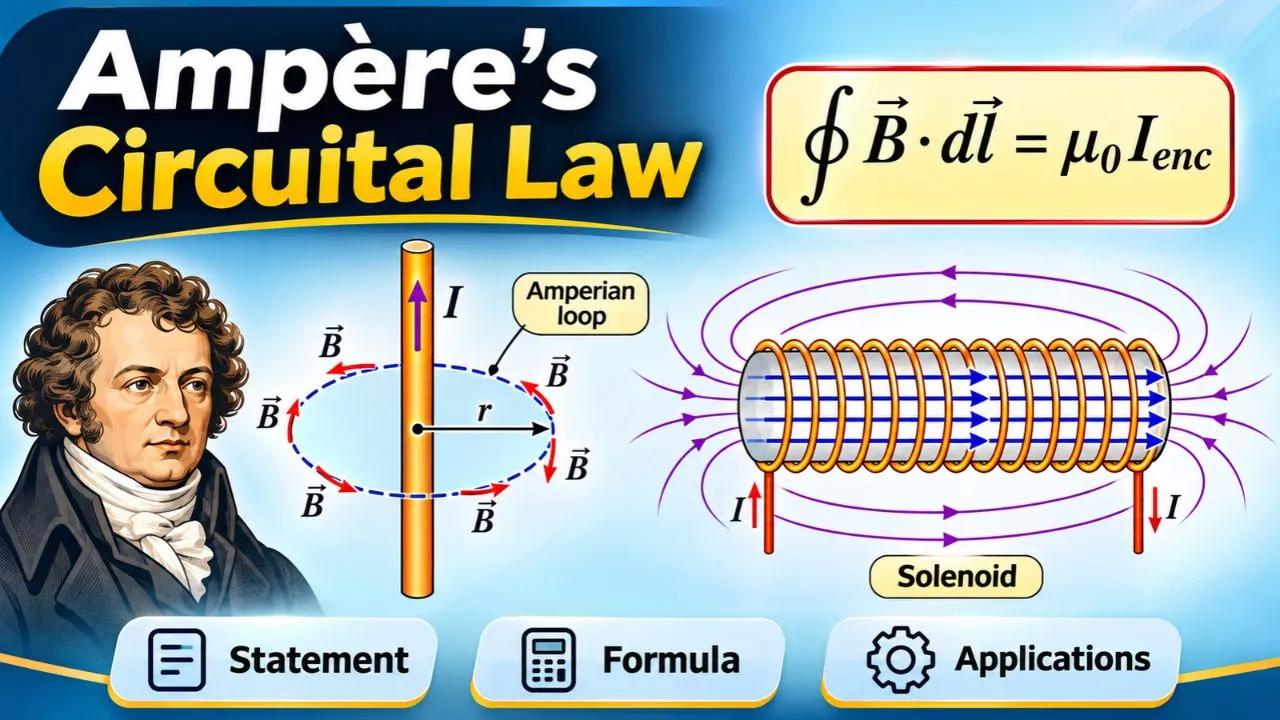
Ampère’s circuital law, often simply called Ampère’s law, states that the line integral of the magnetic field around any closed path is equal to the permeability of free space multiplied by the net current enclosed by that path. This applies to steady currents in vacuum or air under the usual approximation.
The law is similar to Gauss’s law in electrostatics, but instead of a closed surface, it uses a closed path called an Amperian loop. An Amperian loop is an imaginary path, not a physical wire, chosen to exploit the symmetry of the current distribution.
Statement of Ampère’s Circuital Law
The mathematical statement of Ampère’s circuital law is:
Where:
| Symbol | Meaning | SI unit |
 | Magnetic field | tesla (T) |
 dl  | Small element of the closed path | metre (m) |
| ∮ | Integration over a complete closed path | — |
| μ₀ | Permeability of free space | T·m/A |
| Ienc | Net current enclosed by the path | ampere (A) |
The dot product :
means that only the component of the magnetic field along the path contributes to the line integral. Here, θ is the angle between the magnetic field and the path element.
What Is an Amperian Loop?
An Amperian loop is an imaginary closed path chosen to make the calculation of the magnetic field easier. For a long straight current-carrying wire, a circular loop centered on the wire is the natural choice because of the symmetry of the setup.
The loop is chosen so that the magnetic field is either tangential to the loop at all points, or tangential over part of it and normal over the rest. The magnitude of the field should also be constant along the parts where it is tangential. This makes the integral straightforward to evaluate.

Magnetic Field Due to an Infinitely Long Straight Current-Carrying Wire
This is the main application of Ampère’s law and the most detailed section.
Physical arrangement and assumptions
Consider an infinitely long straight wire carrying a current I. By symmetry, the magnetic field must form concentric circles around the wire. The field is tangential to these circles, and its magnitude is constant at a given distance from the wire.
Choosing a circular Amperian loop
Choose a circular Amperian loop of radius r centered on the wire. Because the field is tangential and constant in magnitude along the loop, the dot product simplifies to B\,dl.
Applying Ampère’s circuital law
The line integral around the loop is:
The current enclosed by the loop is simply I, the current in the wire. Applying Ampère’s law:
Solving for B:
This result shows that the magnetic field strength is directly proportional to the current and inversely proportional to the distance from the wire.
Magnetic Field Inside a Long Straight Solenoid (Qualitative Explanation)
A solenoid is a coil of wire wound into a cylindrical shape. When current passes through its turns, it produces a magnetic field that is nearly uniform and parallel to the axis inside the solenoid, and much weaker outside.
For a sufficiently long solenoid, the field inside is approximately uniform. The ideal long-solenoid result is:
Where n is the number of turns per unit length. This is an ideal result, and the qualitative explanation is that the field lines inside are nearly parallel and evenly spaced, while outside they are much weaker.

Direction of the Magnetic Field: Right-Hand Thumb Rule
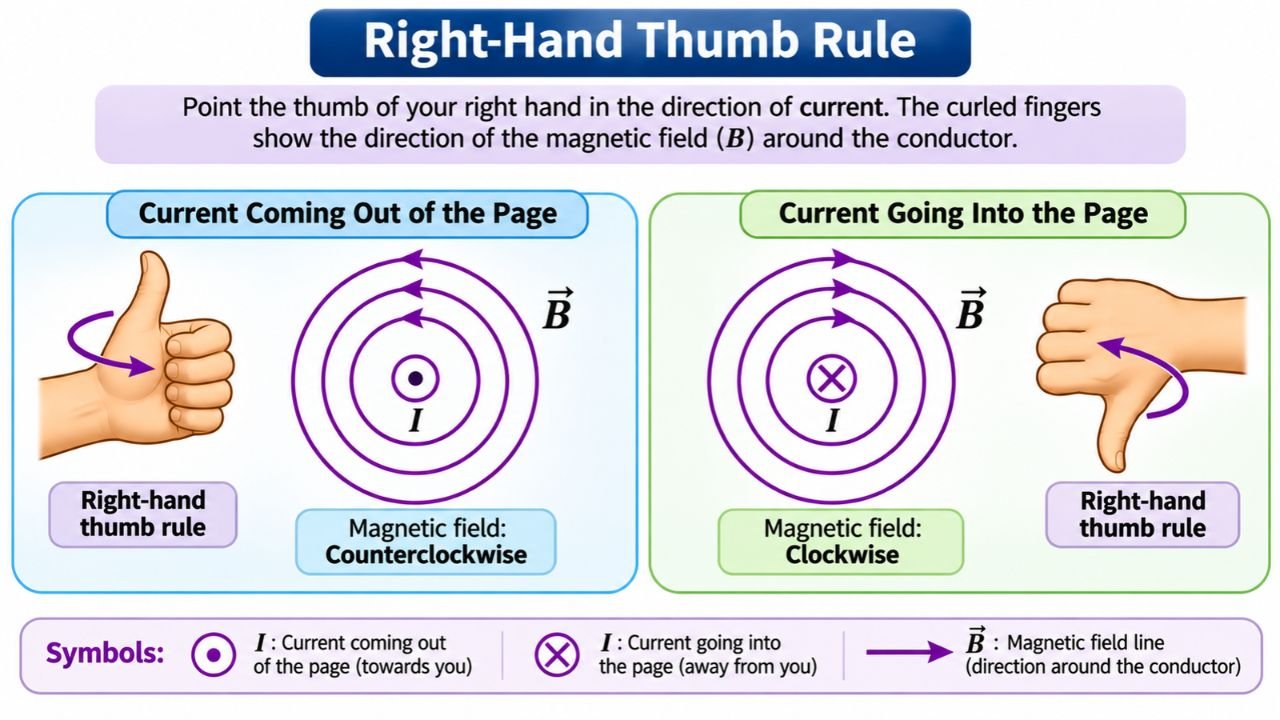
To find the direction of the magnetic field around a current-carrying wire, use the right-hand thumb rule. Point your right-hand thumb in the direction of the conventional current, and your curled fingers indicate the direction of the magnetic field.
Solved Numerical Problems
Problem 1: Find the magnetic field at a given distance from a long straight wire
A long straight wire carries a current of 10 A. Calculate the magnetic field at a point 5 cm away from the wire.
Given:
Answer: The magnetic field is 4×10⁻⁵ T. The field becomes weaker as the observation point moves farther from the wire.
Problem 2: Calculate the current when the magnetic field and distance are known
A magnetic field of 2×10⁻⁵ T is measured at a distance of 10 cm from a long straight wire. Find the current.
Given:
Answer: The current is 10 A.
Problem 3: Compare magnetic fields at two different distances from the same wire
A wire carries 5 A. Compare the magnetic field at 2 cm and 4 cm from the wire.
At 2 cm:
At 4 cm:
Answer: The field at 4 cm is half the field at 2 cm, because the field is inversely proportional to distance.
Importance and Applications of Ampère’s Law
Ampère’s law is important because it allows us to calculate magnetic fields for symmetric current distributions. Examples include long straight conductors and solenoids. Other symmetric systems, like toroids, can also be analyzed using this law.
Limitations of Ampère’s Circuital Law
The simple steady-current form of Ampère’s law is not the complete description for changing electric fields. Also, although the law is general for steady currents, it is most useful for finding the magnetic field directly when the system has sufficient symmetry.
It is important to distinguish two ideas: the law itself is not limited only to symmetric systems, but its straightforward use for calculating B is.
Ampère–Maxwell Law (Additional Knowledge)
Maxwell extended Ampère’s law to handle time-varying electric fields by introducing displacement current. The Ampère–Maxwell law is:
This is additional understanding, not a compulsory Class 12 derivation unless the student’s board specifically includes it.
Frequently Asked Questions
Q: What is Ampère’s circuital law in simple words?
It states that the line integral of the magnetic field around a closed path equals the permeability of free space times the net current enclosed by that path.
Q: What is the formula for Ampère’s circuital law?
Q: What is an Amperian loop?
An imaginary closed path chosen to exploit the symmetry of a current distribution for calculating the magnetic field.
Q: What is the SI unit of magnetic field?
The SI unit is the tesla (T).
Q: What is the magnetic field due to a long straight wire?
Q: Why is a circular Amperian loop used around a straight wire?
Because the symmetry of the setup makes the field tangential and constant in magnitude along the loop, simplifying the integral.
Q: What is the difference between Ampère’s law and the Ampère–Maxwell law?
Ampère’s law applies to steady currents. The Ampère–Maxwell law includes displacement current to handle time-varying electric fields.
Key Points
- Ampère’s law relates the line integral of the magnetic field around a closed path to the net current enclosed.
- An Amperian loop is an imaginary path chosen for symmetry.
- The right-hand thumb rule gives the direction of the magnetic field.
- The Ampère–Maxwell law includes displacement current for time-varying fields.
References
- Physics LibreTexts, “Ampere’s Law”: https://phys.libretexts.org/Bookshelves/University_Physics/Book%3A_Introductory_Physics_Building_Models_to_Describe_Our_World(Martin_Neary_Rinaldo_and_Woodman)/22%3A_Source_of_Magnetic_Field/22.03%3A_Amperes_Law
- Wikipedia, “Ampère’s circuital law”: https://en.wikipedia.org/wiki/Amp%C3%A8re%27s_circuital_law
- University of Delhi, “Ampere’s Circuital Law and its Applications”: https://www.deshbandhucollege.ac.in/pdf/resources/1585301756_PHY(H)-II-ElECTRICITY_MAGNETISM_%26_EMT-13.pdf