When salt is spread over an icy road, it can make ice melt even when the surrounding air is below 0°C. The short answer is that salt lowers the freezing point of water.
This means that water which would normally freeze at 0°C can stay liquid at a lower temperature when salt is dissolved in it, so existing ice can melt into a salty liquid called brine.
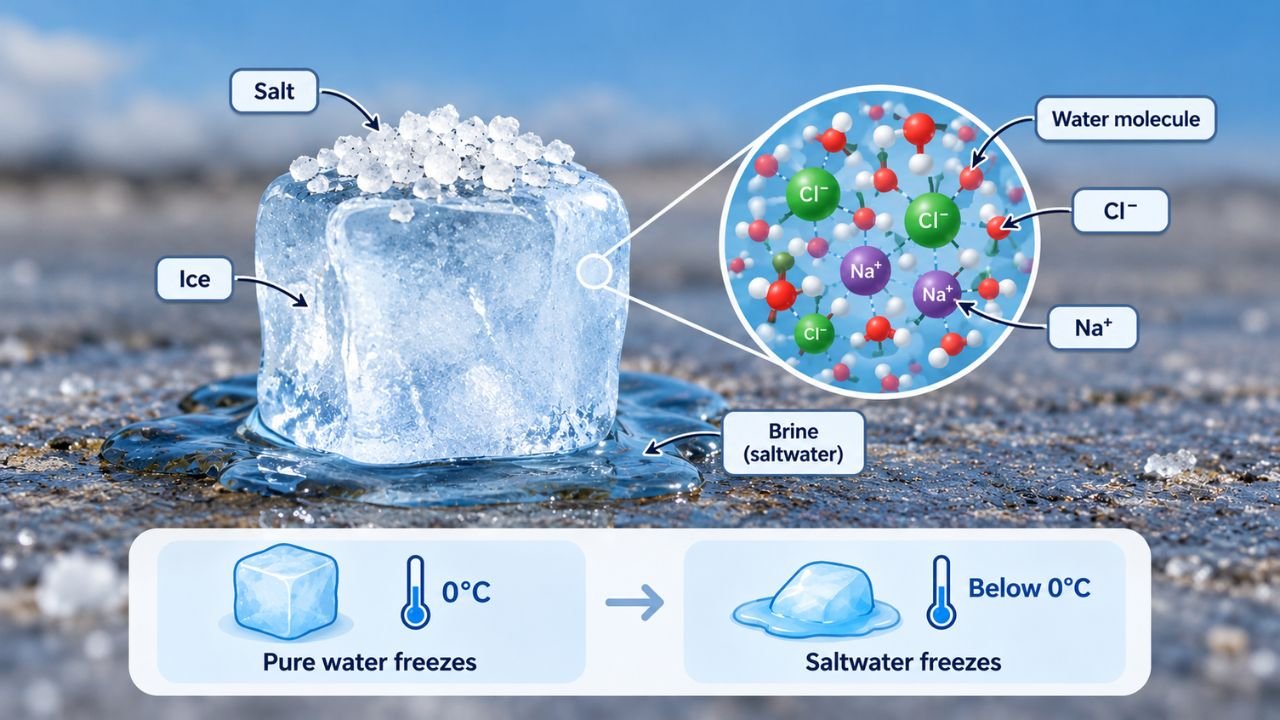
Why Does Salt Melt Ice?
Ordinary table salt is sodium chloride, written as NaCl. When it comes into contact with ice, it dissolves in the thin layer of liquid water that is always present on the ice surface, even at temperatures below freezing. As the salt dissolves, it separates into sodium ions (Na⁺) and chloride ions (Cl⁻).
This saltwater solution, called brine, has a lower freezing point than pure water. Because of this, the ice can no longer stay in equilibrium with the liquid at 0°C, and it begins to melt. The salt does not supply the main heat needed to melt the ice.
Instead, it changes the conditions so that ice and liquid water are no longer in balance at the original freezing temperature.
How Does Salt Melt Ice at the Molecular Level?
Water molecules in ice are arranged in a rigid, ordered crystal structure held together by hydrogen bonds. Pure water freezes at 0°C because its molecules can lock into this structure at that temperature.
When salt dissolves, the sodium and chloride ions become surrounded by water molecules. This is called hydration. These ions interfere with the ability of water molecules to arrange themselves into the pure ice crystal. As a result, water molecules find it harder to freeze at 0°C, so the freezing point drops.
The ice then melts into salty liquid water, or brine. This brine can spread across the surface and prevent new ice from forming easily. It is important to understand that salt does not literally break the ice apart.
It changes the balance between freezing and melting, so melting becomes favored at temperatures where pure water would normally stay frozen.
What Is Freezing-Point Depression?
Freezing-point depression is the lowering of a liquid’s freezing point when a solute is dissolved in it. Pure water freezes at approximately 0°C at normal atmospheric pressure, but saltwater freezes at a lower temperature. The more dissolved particles there are, the lower the freezing point becomes.
This is an example of a colligative property. A colligative property depends mainly on the number of dissolved particles in a solution, not on what those particles are made of. This is why sugar, alcohol, and salt can all lower the freezing point of water, even though they are chemically very different.
Why Does Salt Work Below 0°C?
Pure ice and saltwater have different freezing points. Pure water freezes at 0°C, but saltwater freezes at a lower temperature. When salt is added to ice, some of the ice melts and forms brine. As long as the temperature is above the freezing point of that brine, the ice can continue to melt.
This is why salt can work below 0°C. It is not that salt magically makes ice melt at any temperature. It works only when the temperature is above the freezing point of the brine that forms. If it gets too cold, even the brine will freeze, and salt stops being effective.
Why Does Salt Become Less Effective in Extreme Cold?
As temperatures drop, it becomes harder for ordinary road salt to dissolve and produce enough brine quickly. At very low temperatures, the salt may not dissolve fast enough to keep up with the freezing conditions.
The sodium chloride and water system has an equilibrium eutectic temperature near −21.1°C at a specific concentration. This is the lowest temperature at which a salt and water mixture can stay liquid.
However, this does not mean road salt will perform well all the way down to that temperature. In practice, sodium chloride becomes much less effective well before that point, often around −10°C for road use.
In colder conditions, other salts like calcium chloride or magnesium chloride are sometimes used because they can produce brine at lower temperatures. Their effectiveness still depends on the product, the amount used, and the actual weather conditions.
Does Salt Make Ice Colder?
Salt can help create a salt and ice mixture that is colder than 0°C. This is different from saying that salt always cools ice when you sprinkle it on top.
The actual temperature depends on how much salt is used, the surrounding temperature, and how much heat is exchanged during melting and dissolving.
When ice melts, it absorbs heat from its surroundings. This is called an endothermic process. In a salt and ice mixture, this heat absorption can lower the temperature of the mixture below 0°C, which is why salt and ice are sometimes used to make ice cream.
Which Salt Melts Ice Best?
Different salts have different strengths and weaknesses.
| Salt | Relative cost | Low-temperature performance | Environmental note |
| Sodium chloride (NaCl) | Low | Works well near 0°C, less effective below about −10°C | Can increase salinity in freshwater and soil |
| Calcium chloride (CaCl₂) | Higher | Can work at lower temperatures than NaCl | Can be more corrosive and affect vegetation |
| Magnesium chloride (MgCl₂) | Moderate | Can work at lower temperatures than NaCl | Can affect soil and water quality |
No single salt is best in every situation. The right choice depends on temperature, cost, environmental impact, and the specific application.
A Simple Experiment to Demonstrate How Salt Melts Ice
You can demonstrate this at home or in a classroom.
Take two identical ice cubes and place them in two separate containers. Sprinkle a measured amount of salt on one cube and leave the other untreated.
Observe which cube melts faster and collect the liquid that forms. If you have a thermometer, measure the temperature of the liquid in both containers over time.
What you should see is that the salted ice melts faster and produces a salty liquid (brine). The untreated ice melts more slowly.
This demonstrates that salt lowers the freezing point of water, allowing ice to melt at temperatures where pure water would stay frozen. It does not prove that salt produces heat or that it works at every temperature.
Why Is Salt Used on Roads, and What Are Its Environmental Effects?
Salt is used on roads because it helps melt existing ice and can reduce refreezing under suitable conditions. This makes roads safer for vehicles and pedestrians.
However, salt runoff can affect freshwater, soil, vegetation, and aquatic organisms. Too much salt can increase the salinity of rivers and lakes, harming freshwater species. It can also damage plants and corrode vehicles and infrastructure.
Because of this, it is important to use an appropriate amount of salt rather than assuming that more salt always produces better results. Using too much can be wasteful and harmful to the environment without providing much extra benefit.
Freezing-Point Depression Formula
For students studying Solutions and Colligative Properties, the freezing-point depression can be calculated using this formula:
ΔTf=iKfm
Where:
- ΔTf = depression in freezing point
- i = van ’t Hoff factor, accounting for the number of dissolved particles
- Kf = molal freezing-point depression constant of the solvent
- m = molality of the solution
For an ideal dilute solution, NaCl is often approximated as producing two ions per formula unit, so i is approximately 2. In real solutions, ion interactions mean the effective value may differ slightly.
Worked example
Suppose you dissolve 0.25 mol of NaCl in 1 kg of water. Using i = 2 and Kf = 1.86 °C/m for water:
ΔTf = (2)(1.86)(0.25) = 0.93 °C
So the freezing point of the solution would be:
0 – 0.93 = -0.93 °C
This means the saltwater solution would freeze at about −0.93°C instead of 0°C.
Frequently Asked Questions
Why does salt melt ice?
Salt melts ice because it dissolves in the thin water layer on the ice surface and lowers the freezing point of that water. This creates brine, which can stay liquid below 0°C, causing the ice to melt.
Does salt melt ice below 0°C?
Yes, but only if the temperature is above the freezing point of the brine that forms. Salt becomes less effective as temperatures drop further.
Why does salt lower the freezing point of water?
Salt ions interfere with the ability of water molecules to form the ordered ice crystal structure. This makes it harder for water to freeze at 0°C, so the freezing point drops.
Does salt actually break the bonds in ice?
No. Salt does not directly break the hydrogen bonds in ice. It changes the balance between freezing and melting, so melting becomes favored at lower temperatures.
Why does salt stop working in extreme cold?
At very low temperatures, salt cannot dissolve fast enough to produce enough brine. The brine itself may also freeze, so salt stops being effective.
Does salt make ice colder?
Salt can help create a salt and ice mixture colder than 0°C because melting ice absorbs heat. But this depends on the amount of salt and the conditions.
Which melts ice faster, table salt or calcium chloride?
Calcium chloride can work at lower temperatures than table salt, but table salt is cheaper and works well near 0°C. The best choice depends on the temperature and application.
Can sugar melt ice like salt?
Yes, sugar can also lower the freezing point of water because it is a solute. However, salt is more effective per unit mass because it produces more dissolved particles (ions) in solution.
Why is salt used on icy roads?
Salt is used on icy roads because it lowers the freezing point of water, helping to melt existing ice and prevent new ice from forming. This makes roads safer.
Is salt melting ice a chemical or physical change?
Melting ice is a physical change because the water molecules do not change chemically. Dissolving sodium chloride in water is also generally treated as a physical process under these conditions.
Key Takeaways
- Salt melts ice because it lowers the freezing point of water.
- This is called freezing-point depression, a colligative property.
- Salt dissolves into sodium and chloride ions, which interfere with ice crystal formation.
- Salt works below 0°C only if the temperature is above the freezing point of the brine.
- Salt becomes less effective in extreme cold, with sodium chloride becoming unreliable below about −10°C for road use.
- Salt does not produce heat to melt ice; it changes the freezing-melting balance.
- Using too much salt can harm the environment without providing much extra benefit.
References
- Britannica, “Why Does Salt Melt Ice?”: https://www.britannica.com/print/article/2268398
- IET Education, “Why does ice melt?”: https://education.theiet.org/primary/teaching-resources/why-does-ice-melt
- NASA Salinity, “Can Sea Water Freeze?”: https://salinity.oceansciences.org/learn/can_sw_freeze.pdf
- ACS ChemMatters, “The Solution for Winter Driving”: https://www.acs.org/content/dam/acsorg/education/resources/highschool/chemmatters/articlesbytopic/solutions/chemmatters-feb2006-salting-roads.pdf
- Wikipedia, “Freezing-point depression”: https://en.wikipedia.org/wiki/Freezing-point_depression
- TAC, “Salt Use on Private Roads, Parking Lots”: https://www.tac-atc.ca/wp-content/uploads/roadsalt-10.pdf
- Science Buddies, “Chemistry of Ice-Cream Making”: https://www.sciencebuddies.org/Content/PDFs/ProjectIdeasKits/FoodSci_p013/FoodSci_p013_20130906.pdf