Lightning is an electrical discharge caused by strong electric fields and charge imbalances that develop inside a thunderstorm or between a cloud and the ground.
When the electrical insulation of air brakes down, charge moves rapidly through the air, producing the bright flash we see and the thunder we hear.
What Is Lightning?
Lightning is a rapid electrical discharge in the atmosphere. It can occur within a single cloud, between two clouds, or between a cloud and the ground.
To understand lightning, you need to know three basic physics terms.
- Electric charge is a property of matter that can be positive or negative. Protons carry positive charge and electrons carry negative charge. Like charges repel each other, while opposite charges attract.
- Electric field is the region around a charge where other charges experience an electrical force. The stronger the charge imbalance, the stronger the electric field.
- Electrical discharge is a rapid movement of charge through a conducting path. Lightning is a very large and powerful electrical discharge through air.
Lightning is a giant spark of electricity that happens in the atmosphere, either between clouds, within a single cloud, or between a cloud and the ground.
To understand how it works, imagine the air as a barrier that normally keeps opposite electric charges apart. In the early stages of a thunderstorm, this barrier holds strong, so no lightning occurs yet.
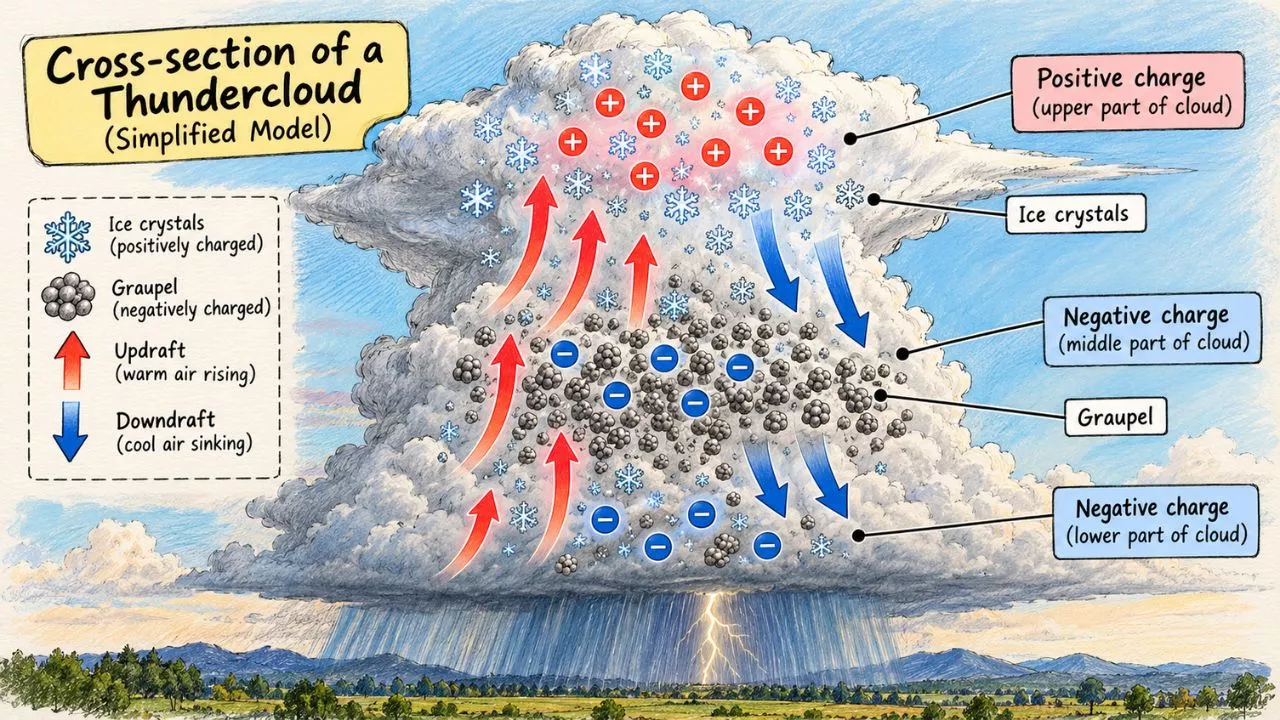
Inside a thunderstorm cloud, positive and negative charges build up in different regions. The top of the cloud often becomes positively charged, while the middle and lower parts become negatively charged.
At the same time, the ground below can also build up an opposite charge. As more and more charge collects, the electric field between these regions becomes stronger and stronger.
Eventually, the charge buildup becomes so great that the air can no longer act as an insulator. When this happens, the air briefly becomes a conductor, and a huge amount of electricity rushes through it in a fraction of a second. This sudden rush of electricity is what we call lightning. The flash we see is the light given off by this discharge.
After the lightning strike, the charged regions in the atmosphere are temporarily balanced out, or equalized. However, the thunderstorm continues to move particles around inside the cloud, so the charges start building up again. This is why lightning can strike multiple times during the same storm.
Lightning does not only happen between a cloud and the ground. It can also occur entirely within one cloud, which is called intra cloud lightning. It can also happen between two separate clouds, which is called cloud to cloud lightning. When lightning travels from a cloud down to the ground, it is called cloud to ground lightning.
Lightning is one of the oldest natural phenomena that humans have observed. It is not limited to thunderstorms. Lightning can also be seen during volcanic eruptions, extremely intense forest fires, surface nuclear detonations, heavy snowstorms, and large hurricanes.
In all these cases, the same basic process happens: charges separate, the electric field becomes strong enough, and air briefly conducts electricity, producing a lightning flash.
How Do Thunderstorms Create the Conditions for Lightning?
A thunderstorm needs three main things to form: moisture, unstable air, and upward movement of warm air. Think of it like a recipe. Without any one of these ingredients, a thunderstorm cannot develop properly.
First, there must be moisture in the air. This moisture comes from water that has evaporated from oceans, lakes, rivers, and wet ground. When this moist air rises higher into the sky, it cools down.
As it cools, the water vapor in the air condenses, meaning it turns from an invisible gas into tiny liquid water droplets. These droplets gather together to form clouds.
Second, the air must be unstable. Unstable air means that once warm air starts rising, it keeps rising on its own because it is warmer and lighter than the air around it.
This is similar to how a hot air balloon rises because the hot air inside is lighter than the cooler air outside. In the atmosphere, this rising warm air is called an updraft.
Third, there must be upward movement of warm air. This rising motion is what keeps the storm growing. As the warm air rises, it pulls more moist air up with it, feeding the cloud and making it bigger.
Inside the thundercloud, these rising and falling air currents, called updrafts and downdrafts, carry tiny particles up and down. These particles include water droplets, ice crystals, and small ice pellets called graupel or soft hail.
The updrafts push lighter particles upward, while gravity pulls heavier particles downward. This creates a lot of movement and collisions between the particles.
This constant movement and collision of particles is very important because it is what creates the conditions for charge separation.
When ice crystals and graupel particles bump into each other, they can transfer tiny amounts of electric charge from one to the other. Over time, this builds up different charges in different parts of the cloud.
However, Thunderstorm formation and lightning initiation are related but not the same thing. A thunderstorm provides the environment where electric charges can build up and separate. But lightning does not happen in every thunderstorm.
For lightning to actually occur, the charge buildup must become strong enough to overcome the insulating properties of air and force a discharge. In other words, the storm sets the stage, but lightning only happens when the conditions are just right.
How Do Electrical Charges Build Up Inside a Cloud?
Inside a thundercloud, collisions between ice crystals and larger ice particles, such as graupel or soft hail, can transfer electric charge. The outcome of these collisions depends on conditions like temperature and the presence of supercooled liquid water.
In a common simplified model, when ice crystals collide with graupel, the ice crystals become positively charged and the graupel becomes negatively charged.
Because the lighter ice crystals are carried upward by updrafts, while the heavier graupel falls or stays lower in the cloud, the charges get separated.
The result is a common charge pattern: the upper part of the thunderstorm cloud becomes positively charged, while the middle and lower parts become negatively charged.
It is important to note that this is a simplified model. Real cloud charge structures can be more complex and vary from storm to storm.
It is incorrect to say that ordinary friction alone completely explains lightning. Charge separation through particle collisions and air movement is well established, but the exact process that initiates a lightning discharge is still an active area of research.
How Does Lightning Form?
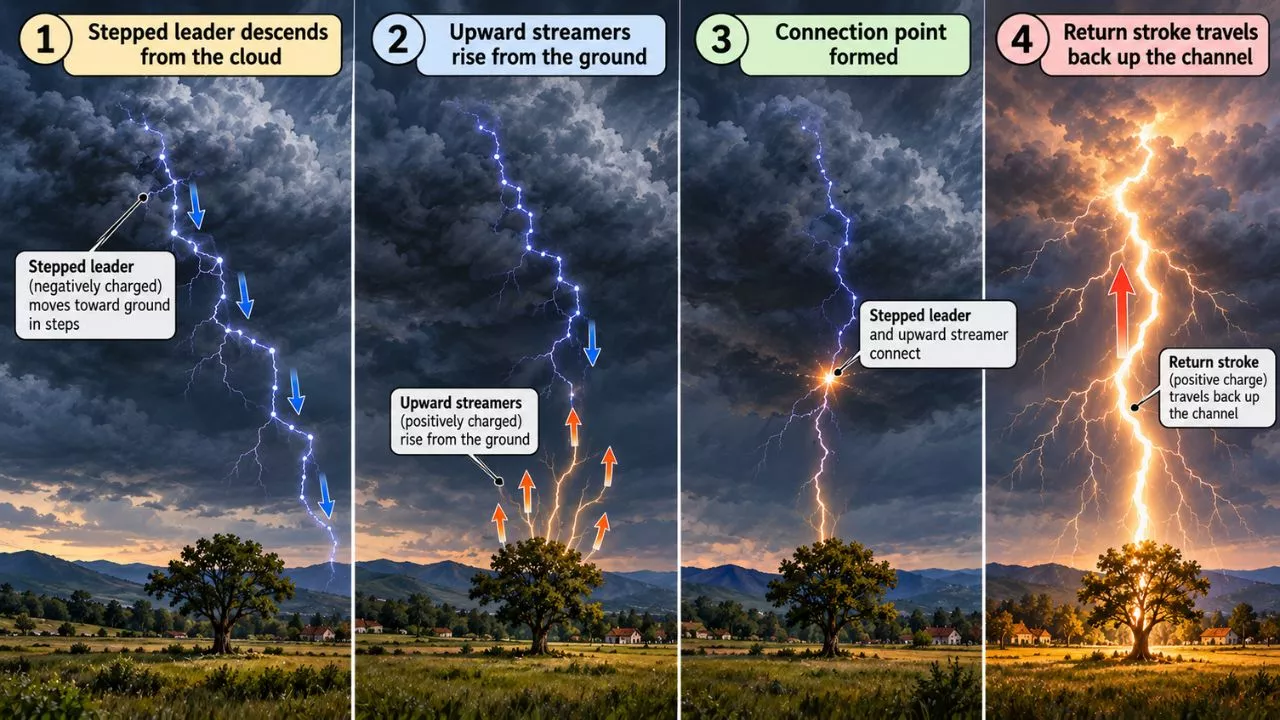
Here is the typical sequence for a negative cloud-to-ground lightning flash, which is one of the most common types.
- Charge regions form inside the thundercloud. Collisions and air movements separate positive and negative charges, creating a strong electric field.
- The electric field strengthens. As more charge builds up, the electric field between the charged regions, and between the cloud and the ground, becomes stronger.
- A stepped leader begins to descend from the cloud. In a cloud-to-ground flash, a faint, negatively charged channel called a stepped leader moves downward from the cloud base toward the ground in a series of steps.
- Upward streamers develop from the ground. As the stepped leader gets close to the ground, positive charge builds up on the surface and on tall objects. This can cause upward-moving channels called streamers to reach toward the descending leader.
- A connection forms between the channels. When the stepped leader meets an upward streamer, a conductive path is established between the cloud and the ground. This is called the attachment process.
- A powerful return stroke travels along the connected channel. A large surge of charge moves rapidly along the path, producing the bright flash of light we see as lightning.
This describes a common negative cloud-to-ground flash. Not every lightning flash travels to the ground. Many flashes stay entirely within a cloud or travel between clouds.
Why Does Lightning Look Like a Bright, Zigzag Flash?
When the electrical discharge occurs, it heats the air along its path to extremely high temperatures. This intense heat ionizes the air, turning it into a hot, electrically conducting channel of plasma. Plasma emits intense light, which is why lightning appears so bright.
The lightning channel does not follow a straight line. It branches and zigzags because the stepped leader moves through the air in irregular steps, following the path where ionization happens most easily.
It is not accurate to say lightning always follows the “shortest path” or simply the “path of least resistance.” The actual path depends on the electric field and the conditions in the air.
A single flash may contain multiple strokes along related channels, which is why lightning sometimes appears to flicker.
What Causes Thunder After Lightning?
Thunder is caused by the rapid heating and expansion of air along the lightning channel. When lightning heats the air, the air expands suddenly, creating a shock wave that travels outward as sound. This is what we hear as thunder.
Light travels much faster than sound. This is why we see the lightning flash before we hear the thunder. Light reaches us almost instantly, while sound takes time to travel.
As a rough estimate, sound travels about 1 mile in 5 seconds, or about 1 kilometre in 3 seconds. So if you count the seconds between the flash and the thunder, you can estimate how far away the lightning struck. For example, if you count 10 seconds, the lightning is roughly 2 miles or about 3.3 kilometres away.
What Are the Main Types of Lightning?
Lightning can occur in several different ways, depending on where the discharge happens.
| Type | Explanation |
| Intra-cloud | Discharge within one cloud; very common |
| Cloud-to-cloud | Discharge connecting separate clouds |
| Cloud-to-ground | Discharge between a cloud and the ground |
| Ground-to-cloud / upward lightning | Discharge that develops upward from a tall object or structure |
| Positive cloud-to-ground | Ground flash associated with a positively charged region of the cloud |
“Heat lightning” usually refers to distant lightning whose thunder cannot be heard because the sound has faded over the long distance. It is not a separate physical mechanism of lightning.
What Do Scientists Still Not Fully Understand About Lightning?
Scientists understand how charges separate inside thunderclouds and how a lightning flash propagates once it starts. However, the exact process that initiates the very first lightning channel is still not fully understood and remains an active research question.
Recent research has explored whether high-energy electrons, X-rays, gamma ray bursts, and cosmic ray showers might play a role in starting a lightning discharge.
One idea is that a cosmic ray particle could trigger a cascade of high energy electrons inside a cloud, creating enough ionization to start an avalanche that leads to a lightning channel.
These mechanisms are proposed and investigated, but they are not yet settled as the single confirmed cause of lightning initiation. Scientists continue to study this question using observations, simulations, and new instruments.
Why Is Lightning Dangerous, and How Can You Stay Safe?
Lightning can cause burns, cardiac arrest, neurological injury, and fires. It is dangerous because it carries a huge amount of electrical energy in a very short time.
To stay safe during a thunderstorm, follow these guidelines.
- Go inside a substantial enclosed building or a hard-topped vehicle when thunder threatens.
- Avoid open fields, isolated trees, water, and metal objects.
- Wait at least 30 minutes after the last thunder before resuming outdoor activity.
Do not rely on rubber-soled shoes or standing under a tree for protection. These do not prevent lightning strikes.
Frequently Asked Questions About Lightning
Q: What is the main cause of lightning?
Lightning is caused by a buildup of electric charge inside a thunderstorm, which creates a strong electric field. When the field becomes strong enough, air breaks down and a rapid discharge occurs.
Q: Does friction cause lightning?
No. Friction alone does not fully explain lightning. Charge separation happens through collisions between ice particles and air movements inside the cloud, but the exact initiation of lightning is still being researched.
Q: Why does lightning usually occur during thunderstorms?
Thunderstorms provide the moisture, unstable air, and strong updrafts needed to separate electric charges inside a cloud, creating the conditions for lightning.
Q: Why does lightning appear before thunder is heard?
Light travels much faster than sound, so the flash reaches your eyes almost instantly, while the thunder takes longer to reach your ears.
Q: Can lightning occur without rain at the observer’s location?
Yes. Lightning can strike from a storm that is several miles away, even if it is not raining where you are. This is sometimes called a “bolt from the blue.”
Q: Is lightning hotter than the surface of the Sun?
Yes. The air in a lightning channel can reach temperatures much higher than the surface of the Sun, though the exact value varies and should be treated as an approximation.
Q: What is the difference between a lightning leader and a return stroke?
A stepped leader is the initial, faint channel that moves downward from the cloud. A return stroke is the bright, powerful surge of charge that travels back up the connected channel, producing most of the visible light.
Q: Do scientists fully understand how lightning begins?
No. While charge separation is well understood, the exact process that initiates the first lightning channel is still an open research question.
Key Points
- Lightning is a rapid electrical discharge caused by charge imbalances and strong electric fields in a thunderstorm.
- Charge separation happens through collisions between ice crystals and graupel, along with updrafts and downdrafts.
- A common charge pattern has positive charge at the top of the cloud and negative charge in the middle and lower parts.
- In a cloud-to-ground flash, a stepped leader descends from the cloud, meets an upward streamer from the ground, and a return stroke travels back up the channel.
- Thunder is caused by the rapid heating and expansion of air along the lightning channel.
- Light travels faster than sound, which is why we see lightning before hearing thunder.
- The exact process that initiates lightning is still an active area of research, with possible roles for high-energy particles, X-rays, and cosmic rays.
Short quiz
- Why do we see lightning before hearing thunder?
Answer: Because light travels much faster than sound.
- What is a stepped leader?
Answer: A faint, negatively charged channel that moves downward from the cloud toward the ground in steps.
- What causes thunder?
Answer: The rapid heating and expansion of air along the lightning channel, which creates a pressure wave we hear as sound.
- What is the role of ice particles in lightning formation?
Answer: Collisions between ice crystals and graupel transfer charge, helping separate positive and negative charges in the cloud.
- Is friction alone enough to explain lightning?
Answer: No. Friction is an oversimplification. Charge separation involves particle collisions and air movements, and the exact initiation of lightning is still being researched.
References
- National Weather Service, “Understanding Lightning Science”: https://www.weather.gov/safety/lightning-science-overview
- NOAA NESDIS, “What Causes Lightning and Thunder?”: https://www.nesdis.noaa.gov/about/k-12-education/severe-weather/what-causes-lightning-and-thunder
- National Weather Service, “Understanding Lightning: Thunderstorm Electrification”: https://www.weather.gov/safety/lightning-science-electrification
- National Weather Service, “Understanding Lightning: Negative Flash”: https://www.weather.gov/safety/lightning-science-negative-charged-flash
- NOAA National Severe Storms Laboratory, “Severe Weather 101: Lightning Basics”: https://www.nssl.noaa.gov/education/svrwx101/lightning/
- Quanta Magazine, “What Causes Lightning? The Answer Keeps Getting More Interesting” (May 6, 2026): https://www.quantamagazine.org/what-causes-lightning-the-answer-keeps-getting-more-interesting-20260506/