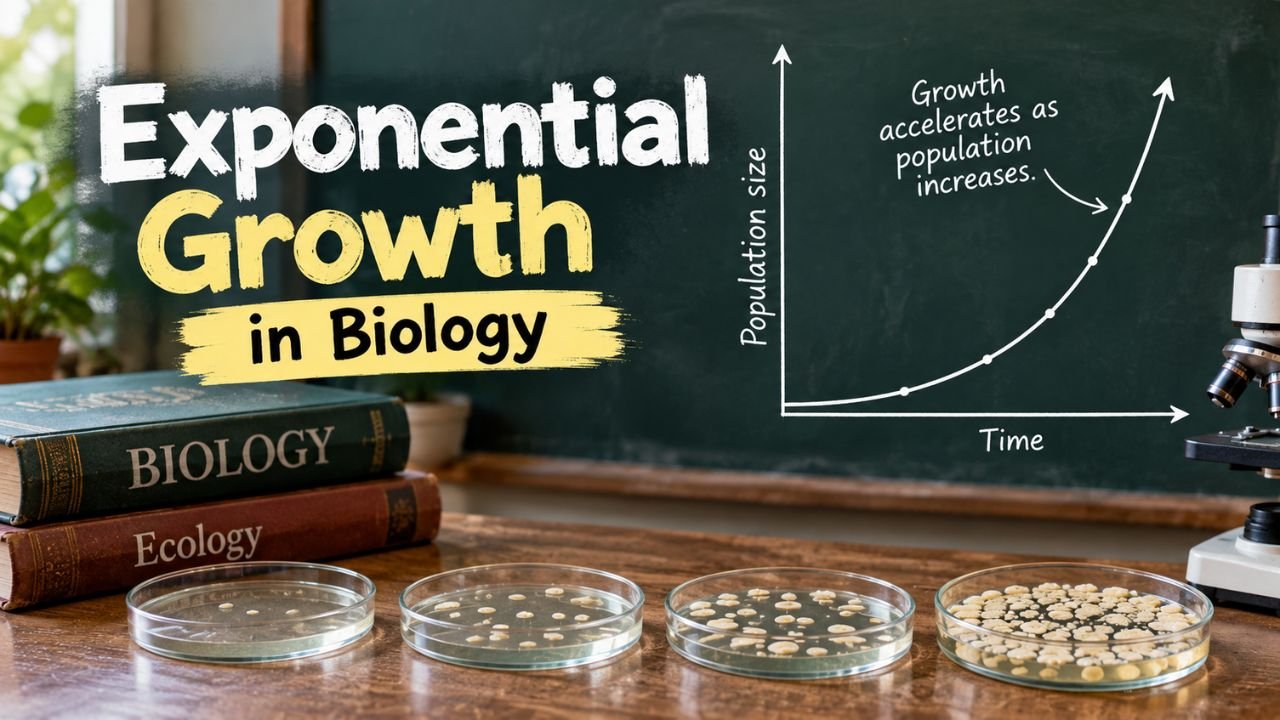
Exponential growth in biology is the rapid increase in a population when every individual has enough food, space, and other resources to survive and reproduce. In this model, the population does not grow by the same number each generation; it grows by an increasingly larger amount because more individuals are present to reproduce. The standard equation is  , and the resulting graph is a J-shaped curve.
What Is Exponential Growth in Biology?
Exponential growth is a pattern of population increase in which the growth rate stays proportional to the current population size. In simple words, the larger the population becomes, the faster it grows, because there are more individuals producing offspring.
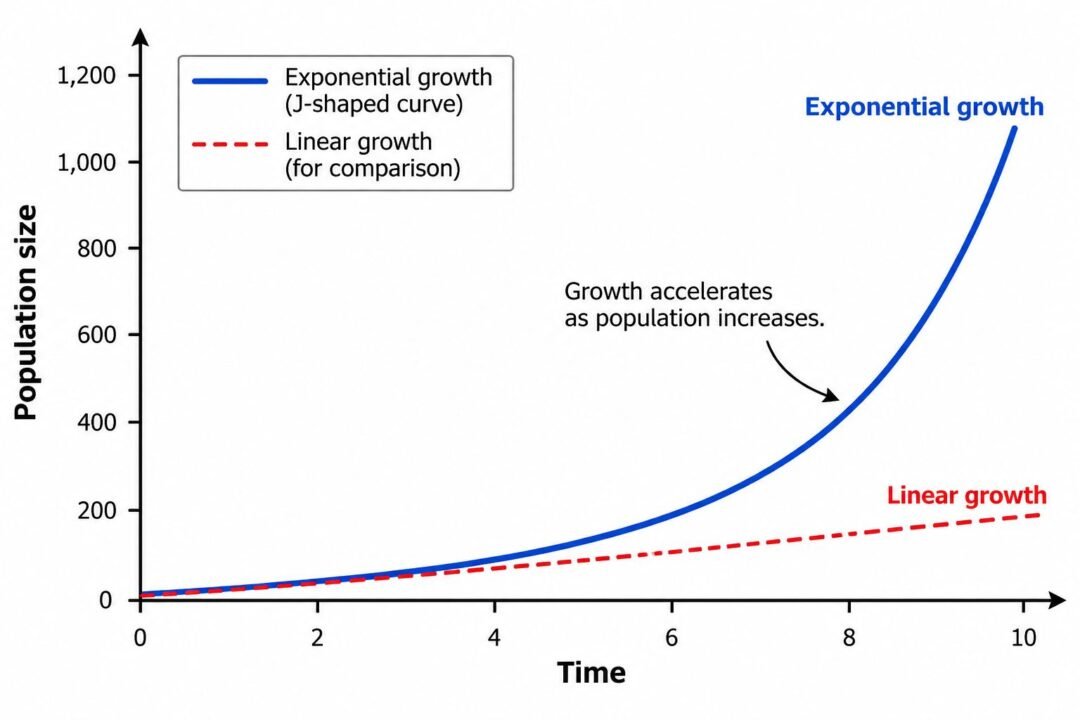
This type of growth is called “exponential” because the population size increases as an exponential function of time. It is different from linear growth, where a population adds the same fixed number of individuals in every time period.
For example, if a population doubles every hour, it may start with 10 individuals, then become 20, 40, 80, and so on. The increase is not 10 every hour; it becomes larger each hour because the base population keeps getting bigger.
How Exponential Growth Works?
Exponential growth works because a population does not just add the same number of individuals each generation. Instead, each new generation has more individuals than the last, and those individuals also reproduce, creating a compounding effect.
The result is that the population grows faster and faster over time, even though the per-capita growth rate stays the same.
In exponential growth, the rate of increase depends on the current population size. A larger population produces more offspring simply because there are more individuals available to reproduce.
This is different from linear growth, where a population adds a fixed number of individuals in every time period. In exponential growth, the amount added keeps getting bigger because the base population keeps getting bigger.
1. Doubling
The easiest way to understand exponential growth is through doubling. If a population doubles at regular intervals, it follows this pattern Imagine a bacterial population that doubles every 20 minutes under ideal laboratory conditions.
If it begins with 1,000 cells, it becomes 2,000 cells after 20 minutes, 4,000 after 40 minutes, and 8,000 after 60 minutes. The population is not simply increasing; it is multiplying.
Each step doubles the previous number. This is why the population grows so quickly, even though the doubling time stays the same.
The time it takes for a population to double is called the doubling time. In exponential growth, this time stays constant.
This is a key feature of exponential growth: the doubling time does not change, but the actual number of new individuals added in each doubling gets larger.
2. Repeated Reproduction.
Exponential growth happens because reproduction is repeated over and over. Each generation produces offspring, and those offspring grow up and reproduce too. This creates a chain reaction.
A simple example with animals
If a pair of animals produces offspring, and those offspring later reproduce, the population grows in stages. The original adults produce young, those young grow up and reproduce more younger, and so on.
This is why exponential growth is often seen in populations that are just starting out in a new environment, where there are few predators and plenty of resources.
3. Increasing Population Size.
As the population gets larger, the same growth rate produces a bigger increase in actual numbers. This is why the exponential growth curve gets steeper over time.
A numerical example
Suppose a population grows at a constant rate of 10% per year.
- Year 1: 100 individuals → 110 individuals (increase of 10)
- Year 2: 110 individuals → 121 individuals (increase of 11)
- Year 3: 121 individuals → 133 individuals (increase of 12)
- Year 4: 133 individuals → 146 individuals (increase of 13)
Notice that the percentage increase stays the same (10%), but the actual number of new individuals keeps getting bigger. This is the essence of exponential growth.
When you plot this growth on a graph, you get a J-shaped curve. At first, the curve is nearly flat because the population is small and the absolute increase is limited. As time passes, the curve bends upward more and more steeply.
This steep rise reflects the compounding effect of more individuals reproducing. The larger the population becomes, the faster it grows.
This is why exponential growth can look slow at first and then become extremely fast. This is because the population is small, so even a high growth rate produces only a small increase in numbers.
For example, if a population of 10 bacteria doubles every 20 minutes, the first few doublings only add a few cells. But after many doublings, the same growth rate produces huge increases because the base population is now large. This is why exponential growth is often described as “slow at first, then explosive.”
The key idea: constant per-capita growth
In an exponential model, the per-capita growth rate stays constant. This means each individual, on average, contributes the same amount to population growth over time.
If the per-capita rate is positive, the population increases. If it is negative, the population decreases. If it is zero, the population stays stable. Exponential growth specifically refers to the case where this rate remains positive and constant.
Conditions Required for Exponential Growth
Exponential growth is a model, not a permanent feature of nature. It assumes ideal conditions that allow a population to keep increasing without limits.
The main conditions are:
- Abundant resources: Food, water, space, nutrients, and other essentials must be available in sufficient quantity.
- Favorable environment: Temperature, pH, oxygen levels, and other conditions must support survival and reproduction.
- Low competition: There must be little competition among individuals for the same resources.
- Minimal limiting factors: Predation, disease, and waste accumulation should not significantly reduce the population.
- Constant per-capita growth rate: Each individual must continue to contribute to growth at roughly the same rate.
In real ecosystems, these conditions rarely last for long. Resources eventually become limited, predators increase, or waste builds up, which slows growth.
That is why exponential growth is usually seen for a short period, often at the start of colonization or in a controlled laboratory setting.
Exponential Growth Formula
The most common form of the exponential growth equation in biology is:

This equation is used to calculate the size of a population after a certain amount of time. It comes from the differential form  , which describes how the rate of change in population depends on the current population size.
What each symbol means
| Symbol | Meaning |
 | Population size (or density) after time  |
 | Population size (or density) at the starting time, when  |
 | Intrinsic rate of natural increase, or per-capita growth rate |
| Time elapsed since the starting point |
| Base of the natural logarithm, approximately 2.71828 |
The value of is especially important. A higher means faster growth. If  is positive, the population increases; if it is negative, the population declines.
The differential form
The exponential growth model can also be written as:

This form says that the rate of change in population size over time depends on the current population size. When  is small, the absolute increase is small. When is large, the same rate produces a much bigger increase in numbers.
Worked Numerical Example
Let’s solve a simple problem step by step.
Problem: A bacterial culture starts with 500 cells. The intrinsic rate of natural increase is  per hour. What will the population size be after 3 hours, assuming exponential growth?
Step 1: Write down the known values.

- per hour
- hours
Step 2: Use the formula.


Step 3: Calculate the exponent.

Step 4: Calculate  .
.

Step 5: Multiply by the starting population.

Answer: After 3 hours, the population will be approximately 4,000 cells.
Notice that the population increased by 3,500 cells in 3 hours, not by the same amount each hour. This is the hallmark of exponential growth: the increase gets larger as the population gets larger.
Exponential Growth Graph: The J-Shaped Curve
When you plot population size against time for exponential growth, you get a J-shaped curve. The curve starts slowly and then rises sharply, resembling the letter “J.”
Axes of the graph
- X-axis (horizontal): Time, usually in hours, days, or generations.
- Y-axis (vertical): Population size or population density, such as number of individuals or cells.
What the shape tells you
At the beginning, the curve is nearly flat because the population is small and the absolute increase is limited. As time passes, the curve bends upward more and more steeply. This steep rise reflects the compounding effect of more individuals reproducing.
The J-shaped curve has no upper limit in the exponential model. It keeps rising indefinitely, which is why it is considered an idealized model rather than a realistic long-term description of natural populations.
Real-Life Examples of Exponential Growth
Exponential growth is most clearly seen in organisms that reproduce quickly and have access to abundant resources. Here are some scientifically appropriate examples.
1. Bacteria in a laboratory culture
Bacteria such as Escherichia coli can double in number every 20 minutes under ideal conditions in a nutrient-rich medium. This makes them a classic example of exponential growth in microbiology.
In a lab setting, scientists can control temperature, nutrients, and waste removal to maintain conditions that support exponential growth for several generations. Eventually, even in a lab, nutrients run out and waste accumulates, slowing growth.
2. Yeast in fermentation
Yeast cells reproduce by budding and can increase rapidly when sugar and nutrients are plentiful. In the early stages of fermentation, yeast populations often show exponential growth before resources become limiting.
3. Algae in a nutrient-rich pond
When excess nutrients (such as nitrogen and phosphorus) enter a pond, algae can multiply rapidly. This rapid increase is a form of exponential growth and can lead to an algal bloom.
However, this example also shows the limits of exponential growth. Once nutrients are used up or light becomes blocked, growth slows or stops, and the bloom may collapse.
Invasive species in a new environment
When a species is introduced to a new area with few natural predators and abundant resources, it can sometimes grow exponentially for a period. Examples include certain invasive plants or animals that spread quickly after introduction.
This growth is temporary. Over time, resource limits, predators, or disease usually slow the population down.
Exponential Growth vs. Logistic Growth
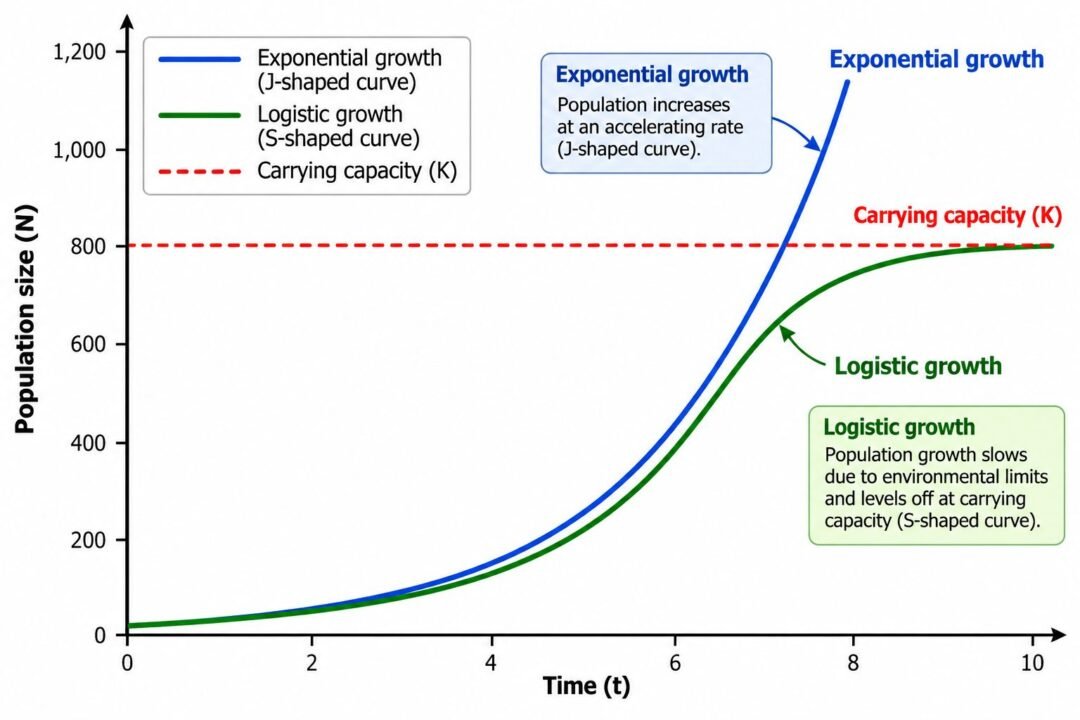
Exponential growth and logistic growth are two models used to describe how populations change over time. The key difference is whether resources are unlimited or limited.
| Feature | Exponential growth | Logistic growth |
| Resource availability | Unlimited (idealized) | Limited |
| Growth pattern | Keeps accelerating | Starts fast, then slows |
| Curve shape | J-shaped | S-shaped (sigmoid) |
| Carrying capacity () | Not included | Included; growth levels off at |
| Long-term outcome | Population rises indefinitely | Population stabilizes near carrying capacity |
| Realism | Short-term or lab conditions | More realistic for natural populations |
| Formula | |  |
In logistic growth, the term  acts as a brake. When the population is much smaller than the carrying capacity , this term is close to 1, and growth is nearly exponential. As approaches , the term approaches 0, and growth slows to nearly zero.
(Image Coming Soon)
Limitations of Exponential Growth
Exponential growth is a useful model, but it has important limitations. It cannot describe what happens to a population over the long term in a real environment.
1. Resources are never truly unlimited
In nature, food, space, water, and nutrients are finite. As a population grows, individuals begin to compete for these resources, which slows reproduction and increases death rates.
2. Environmental resistance increases
As population density rises, factors such as waste buildup, disease spread, and predation become more significant. These factors act as “environmental resistance” and push the population away from exponential growth.
3. The model ignores carrying capacity
The exponential equation has no term for carrying capacity. It assumes the environment can support unlimited population growth, which is not realistic. This is why logistic growth is considered a better long-term model for most natural populations.openstax+1
4. It is most useful for short time frames
Exponential growth is most accurate when describing the early phase of population increase, before resources become limiting. It is also useful in controlled settings like laboratory cultures, where conditions can be maintained artificially for a while.
Importance of Exponential Growth in Biology
Understanding exponential growth is important in several areas of biology and ecology.
1. Population ecology
Ecologists use exponential growth models to understand how populations change when conditions are favorable. This helps them predict how quickly a species might spread after being introduced to a new area.
2. Microbial growth
In microbiology, exponential growth describes how bacterial and yeast populations increase in culture. This is important for understanding infection dynamics, fermentation, and biotechnology.
3. Biological modelling
Scientists use exponential growth equations in mathematical models to estimate population sizes, predict disease spread, and study how species interact with their environment. These models are simplified, but they provide a useful starting point for more complex analysis.
4. Conservation and pest control
Knowing how fast a population can grow under ideal conditions helps conservationists estimate how quickly an endangered species might recover if threats are removed. It also helps pest-control experts predict how quickly an invasive species might spread if not managed.
Frequently Asked Questions
Q: What is exponential growth in biology?
Exponential growth is a pattern where a population increases at a rate proportional to its current size, producing a J-shaped curve over time. It assumes unlimited resources and a constant per-capita growth rate.
Q: What is the formula for exponential growth?
The formula is , where is the population after time , is the starting population, is the intrinsic rate of natural increase, and is approximately 2.71828.
Q: Why is the exponential growth curve J-shaped?
The curve is J-shaped because the population grows slowly at first, when there are few individuals, and then rises sharply as more individuals reproduce and the compounding effect takes over.
Q: What is the difference between exponential and logistic growth?
Exponential growth assumes unlimited resources and produces a J-shaped curve with no upper limit. Logistic growth accounts for limited resources and a carrying capacity, producing an S-shaped curve that levels off.openstax+2
Q: Can exponential growth continue forever in nature?
No. In real environments, resources eventually become limited, and factors like competition, predation, and disease slow growth. Exponential growth is usually a short-term or idealized pattern.openstax+1
Q: What does mean in the exponential growth equation?
is the intrinsic rate of natural increase, or the per-capita growth rate. It tells you how fast each individual, on average, contributes to population growth.
Q: What is an example of exponential growth in real life?
Bacteria in a nutrient-rich laboratory culture often show exponential growth, doubling at regular intervals until nutrients run out. Algal blooms in nutrient-rich ponds are another example.
Key Takeaways
- Exponential growth means a population increases at a rate proportional to its current size.
- The formula is , where each symbol has a specific meaning.
- The graph is J-shaped, rising slowly at first and then steeply.
- It requires abundant resources, favorable conditions, and a constant per-capita growth rate.
- Real populations cannot grow exponentially forever because resources are limited.
- Logistic growth is a more realistic long-term model because it includes carrying capacity.
- Exponential growth is important in ecology, microbiology, conservation, and biological modelling.
Practice Questions
1. A population of 200 bacteria doubles every hour. What will the population be after 4 hours?
A. 800
B. 1,600
C. 3,200
D. 6,400
Answer: C. 3,200. The population doubles each hour: 200 → 400 → 800 → 1,600 → 3,200.
2. In the equation , what does represent?
A. Population after time
B. Starting population
C. Growth rate
D. Carrying capacity
Answer: B. Starting population. is the population size at time zero.
3. Which curve shape represents exponential growth?
A. S-shaped
B. J-shaped
C. Flat line
D. U-shaped
Answer: B. J-shaped. The curve starts slowly and rises steeply as the population grows.
4. Why can’t exponential growth continue indefinitely in nature?
A. Because populations always shrink over time
B. Because resources become limited and competition increases
C. Because all organisms stop reproducing eventually
D. Because the J-shaped curve flattens on its own
Answer: B. Resources become limited and competition increases, which slows growth and pushes the population toward logistic growth.
5. Which model includes carrying capacity ()?
A. Exponential growth
B. Logistic growth
C. Linear growth
D. Geometric growth
Answer: B. Logistic growth. It includes and shows growth leveling off at the carrying capacity.
6. Short answer: Explain why bacterial growth in a lab culture is a good example of exponential growth, and why it eventually slows down.
Answer: In a lab culture, bacteria have abundant nutrients, controlled temperature, and waste removal, so they can double at regular intervals and show exponential growth. Eventually, nutrients are used up and waste accumulates, which slows growth and moves the population toward a logistic pattern.
References and Further Reading
- NCERT, Biology textbook, Chapter on Organisms and Populations: https://ncert.nic.in/textbook/pdf/lebo111.pdf
- OpenStax, Biology 2e, “Environmental Limits to Population Growth”: https://openstax.org/books/biology-2e/pages/45-3-environmental-limits-to-population-growth
- OpenStax, Concepts of Biology, “Population Growth and Regulation”: https://openstax.org/books/concepts-biology/pages/19-2-population-growth-and-regulation
- LibreTexts, “Exponential Growth” in population ecology: https://bio.libretexts.org/Courses/University_of_California_Davis/BIS_2B:Introduction_to_Biology–Ecology_and_Evolution/7:_Population_Growth_and_Dynamics/7.1:_Exponential_Growth