Osmosis is the net movement of water across a selectively permeable membrane from an area of higher water potential to an area of lower water potential. In simple terms, water usually moves from a more dilute solution toward a more concentrated solution when the dissolved substance cannot freely cross the membrane.
What Is Osmosis?
In osmosis, water molecules move across a selectively permeable membrane from the side with higher water potential to the side with lower water potential. More solute generally means lower water potential, because dissolved particles reduce the freedom/availability of water molecules. It is a type of passive transport, so the cell does not need to spend energy to make it happen.
Why It Is Called Passive Transport?
In biology, transport can be active or passive.
- Active transport requires the cell to use energy, usually ATP, to move substances against a gradient.
- Passive transport does not require energy because substances move along a natural gradient.
Osmosis is passive because water moves on its own due to a difference in water potential across a membrane. The cell does not push or pump the water.
Think of it like water flowing downhill. It moves because of a difference in potential energy, not because someone is pushing it.
The Three Key Terms
Water Potential.
Water potential is a measure of the potential energy of water in a system. It tells you how likely water is to move from one place to another. The symbol for water potential is usually Ψ (the Greek letter psi).
Key rule: Water always moves from higher water potential to lower water potential.
For example, pure water has a higher water potential than a salt solution. So if you separate pure water and salt water with a membrane that allows water but not salt to pass, water will move toward the salt solution.
Solute
A solute is a substance that is dissolved in a liquid to form a solution. Common examples are salt in water or sugar in water.
In osmosis, the solute matters because it affects water potential. When you dissolve solute particles in water, they take up space and interact with water molecules, which lowers the water potential of that solution.
Important: The solute itself may not be able to cross the membrane. That is what makes osmosis possible.
Selectively Permeable Membrane
A selectively permeable membrane, also called a semipermeable membrane, allows some substances to pass through more easily than others. In osmosis, the membrane allows water to cross but restricts the movement of many solutes.
Biological membranes, like the plasma membrane around cells, are selectively permeable. They control what enters and leaves the cell.
For osmosis to occur, two conditions must be met:
- There must be a membrane that allows water to pass.
- There must be a difference in water potential on the two sides of the membrane.
Why The Simple Definition Of Osmosis Can Be Misleading?
Many textbooks and teachers say osmosis is “water moving from low concentration to high concentration.” This is not wrong, but it is incomplete and can confuse students.
The problem is: concentration of what?
- If you mean water concentration, then yes, water moves from where water is more concentrated to where it is less concentrated.
- If you mean solute concentration, then water moves from where solute is less concentrated to where solute is more concentrated.
Both statements describe the same thing but from different angles. This is why the precise definition uses water potential instead.
The accurate rule is: water moves from higher water potential to lower water potential. This works in all cases, whether you are talking about pure water, salt solutions, or plant cells.
How Does Osmosis Work?
We know that Osmosis works because water molecules move across a selectively permeable membrane from an area of higher water potential to an area of lower water potential.
The process happens naturally, without the cell using energy, and it continues until equilibrium is reached or another force stops the movement. But how it is work, for that we have to understand the 4 basic steps of Osmosis.
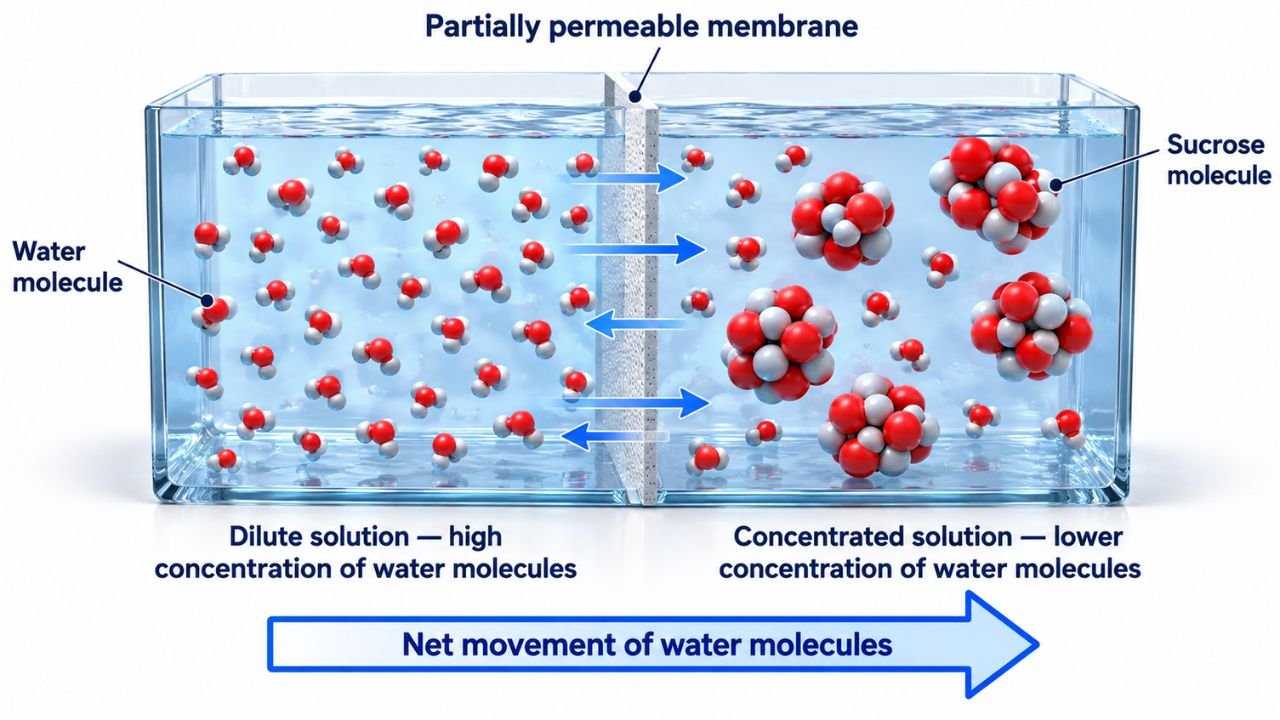
The Four Steps of Osmosis
Let’s break down how osmosis happens, one step at a time.
Step 1: Two solutions are separated by a membrane.
Imagine a container divided into two halves by a selectively permeable membrane. This membrane allows water to pass through easily but restricts the movement of many solutes, such as salt or sugar molecules.
On one side, you might have a dilute solution (less solute, higher water potential). On the other side, you have a concentrated solution (more solute, lower water potential).
For osmosis to occur, the membrane must be more permeable to water than to the solute. This is what makes water move while the solute stays in place.
Step 2: Water molecules move randomly in both directions.
Water molecules are always in motion. They move randomly in all directions, including across the membrane in both directions.
This means water molecules cross from the dilute side to the concentrated side, and also from the concentrated side back to the dilute side. At this stage, both directions are happening at the same time.
The key is that the movement is random, not directed. What creates a pattern is the difference in water potential between the two sides.
Step 3: A difference in water potential causes net movement.
Because one side has higher water potential and the other has lower water potential, more water molecules end up moving toward the lower water potential side. This creates a net movement of water in one direction.
In simple terms:
- The dilute side has higher water potential.
- The concentrated side has lower water potential.
- Net water movement is from the dilute side to the concentrated side.
This is why water seems to flow toward the saltier or sugarier solution. It is not because the solute attracts water, but because the solute lowers the water potential on that side.
Step 4: Net flow slows and stops at equilibrium.
As water moves into the concentrated side, the difference in water potential between the two sides starts to shrink. Eventually, the water potential becomes equal on both sides, and the net movement of water stops.
At this point, the system is said to be at equilibrium.
What Happens at Equilibrium?
This is a point many students misunderstand.
At equilibrium, water molecules do not stop moving. They still cross the membrane in both directions, but the number of molecules moving each way is equal.
Think of it like two busy roads connecting two cities. Cars travel in both directions all the time, but if the number going each way is the same, there is no net change in traffic on either side.
A Simple Example to Visualize
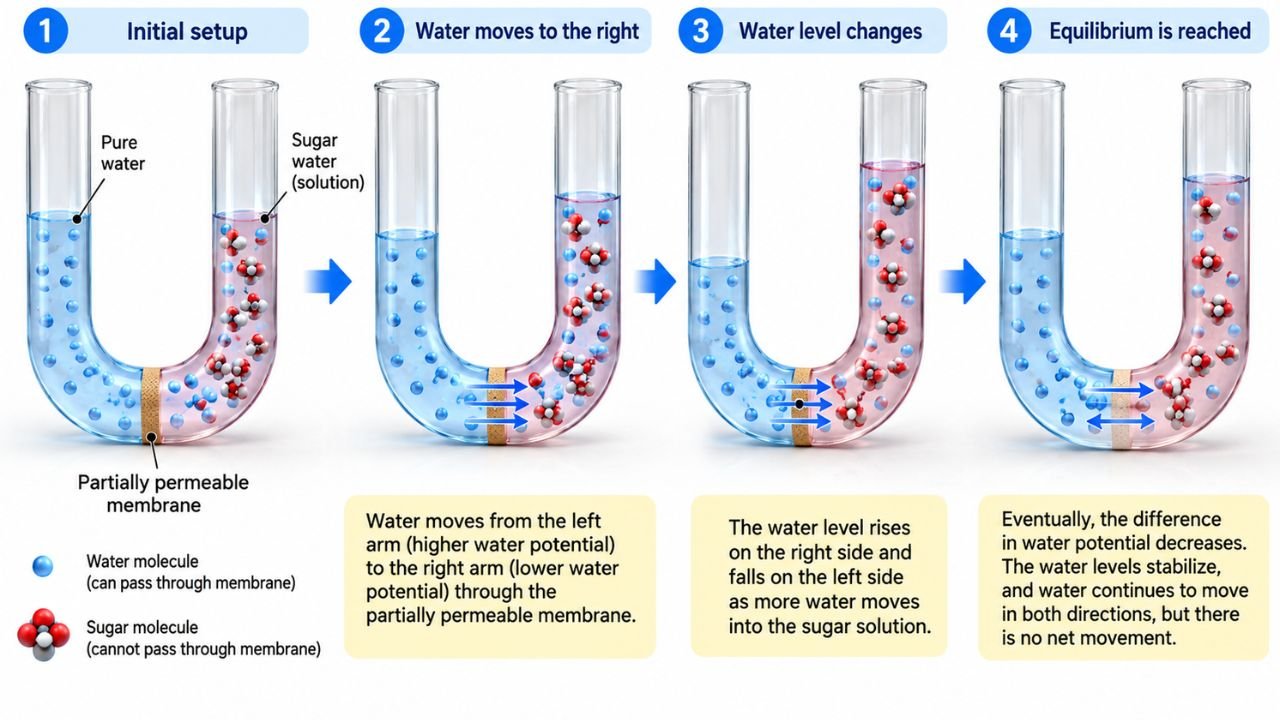
Imagine a U-shaped tube with a membrane at the bottom center.
- Left arm: pure water.
- Right arm: sugar water.
What happens:
- Water moves from the left arm to the right arm through the membrane.
- The water level rises on the right and falls on the left.
- Over time, the difference in water potential decreases.
- Eventually, the levels stabilize, and net movement stops.
At this point, water molecules are still crossing in both directions, but the net flow is zero.
Role Of The Selectively Permeable Membrane In Osmosis.
The membrane is what makes osmosis possible. It allows water to pass while restricting the movement of many dissolved particles, such as large sugar molecules or certain ions.
Biological membranes are not open doors for every substance. Their permeability depends on the molecule’s size, charge, and whether the membrane has specific transport proteins.
Aquaporins are membrane proteins that help water move across some cell membranes more quickly, but the basic idea of osmosis does not depend on knowing every molecular detail.
Direction of Water Movement
Use this simple rule: water moves from higher water potential to lower water potential.
| Condition | Relative water potential | Net water movement |
| Side A has higher water potential | Higher on A | A to B |
| Both sides are at equilibrium | Equal effective water potential | No net movement |
| Side B has higher water potential | Higher on B | B to A |
Under the simple conditions usually taught in introductory biology, adding a nonpenetrating solute lowers water potential.
But pressure and other factors can also affect water potential, so solute concentration is not the only possible influence in every system.
Hypotonic, Hypertonic, And Isotonic Solutions
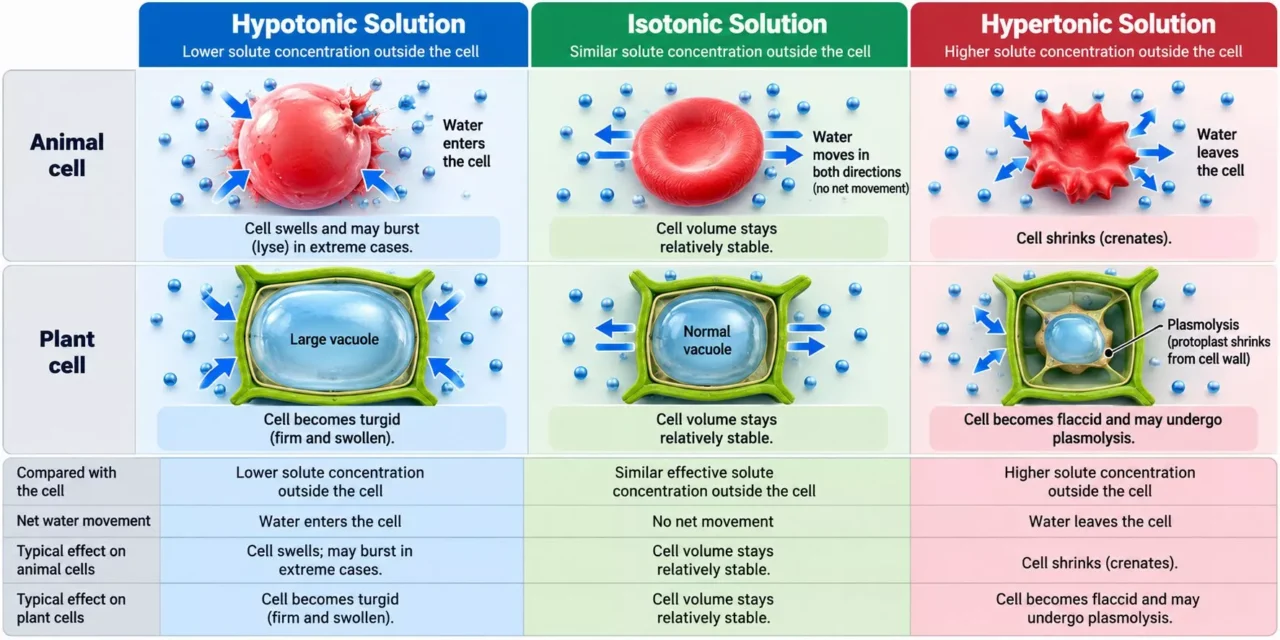
These three terms describe how a solution affects a cell’s volume through osmosis. Tonicity is about the effect of the surrounding solution on the cell, and it often relates to the total concentration of solutes outside the cell.
| Solution type | Compared with the cell | Net water movement | Typical effect on the cell |
| Hypotonic | Lower solute concentration outside the cell | Water enters the cell | Cell swells; plant cells become turgid; animal cells may burst in extreme cases. |
| Hypertonic | Higher solute concentration outside the cell | Water leaves the cell | Cell shrinks; plant cells may undergo plasmolysis; animal cells may crenate. |
| Isotonic | Similar effective solute concentration | No net movement | Cell volume stays relatively stable; water still moves both ways. |
What Happens to Plant Cells In Osmosis?
Plant cells have a rigid cell wall, which changes how they respond to osmosis.
In a hypotonic solution, water enters the cell. The central vacuole expands, pushing the cell membrane against the cell wall. This creates turgor pressure, making the cell firm or turgid.
In an isotonic solution, there is no net water movement, so the cell may become flaccid.
In a hypertonic solution, water leaves the cell. The membrane pulls away from the cell wall in a process called plasmolysis.
A wilted plant can sometimes recover when its roots take up enough water, because turgor pressure returns and the cells become firm again. Wilting can have other causes too, so osmosis is one important factor but not the only explanation.
What Happens to Animal Cells In Osmosis?
Animal cells do not have a rigid cell wall, so they are more vulnerable to changes in water balance.
In a sufficiently hypotonic solution, water enters and the cell can swell, sometimes until it bursts.
In a sufficiently hypertonic solution, water leaves and the cell shrinks, a process called crenation in red blood cells.
In an isotonic solution, the cell maintains a relatively stable volume.
This is why maintaining proper water balance matters so much in animal tissues. Red blood cells are a classic example because their shape and volume change visibly under different tonicity conditions.
Types of Osmosis: Endosmosis and Exosmosis
Osmosis can be described according to the direction of net water movement relative to a cell or compartment. The two terms are endosmosis and exosmosis.
It is important to remember that these are not two different physical mechanisms of osmosis. In both cases, water moves from higher water potential to lower water potential. The terms only describe whether water is entering or leaving the cell.
Endosmosis
Endosmosis is the net entry of water into a cell or compartment.
It occurs when the solution outside the cell has a higher water potential than the inside of the cell. Therefore, water moves from the outside solution into the cell.
Example: Plant Cell in a Hypotonic Solution
A hypotonic solution has a higher water potential than the cell’s internal solution.
When a plant cell is placed in a hypotonic solution, water enters the cell by endosmosis. The water enters the central vacuole and increases the pressure inside the cell.
As a result, the plant cell becomes turgid. Turgidity helps plant cells remain firm and gives support to soft plant tissues.
Endosmosis in Animal Cells
If an animal cell is placed in a hypotonic solution, water enters the cell by endosmosis. The cell may swell because it has no rigid cell wall to resist the entry of water. In extreme cases, the cell may burst.
Exosmosis
Exosmosis is the net exit of water from a cell or compartment.
It occurs when the solution outside the cell has a lower water potential than the inside of the cell. Therefore, water moves from inside the cell to the outside solution.
Example: Plant Cell in a Hypertonic Solution
A hypertonic solution has a lower water potential than the cell’s internal solution.
When a plant cell is placed in a hypertonic solution, water leaves the cell by exosmosis. The central vacuole loses water, and the cell membrane pulls away from the cell wall.
This process is called plasmolysis. A plasmolysed plant cell becomes soft or flaccid.
Exosmosis in Animal Cells
If an animal cell is placed in a hypertonic solution, water leaves the cell by exosmosis. The cell shrinks because it loses water.
Factors That Affect Osmosis
Several factors influence how much water moves during osmosis and how quickly it moves. The main factors are the difference in water potential, temperature, membrane permeability, pressure, and whether the solute can cross the membrane.
1. Difference in Water Potential
The most important factor is the difference in water potential between the two sides of the membrane.
Water moves from a region of higher water potential to a region of lower water potential. A greater difference in water potential usually causes a greater net movement of water.
Under simple conditions, adding a nonpenetrating solute lowers water potential. Therefore, a solution with more effective solute concentration generally has lower water potential.
2. Temperature
Temperature affects the rate of osmosis because it changes the movement of molecules.
At a higher temperature, water molecules move faster. As a result, water molecules cross the membrane more quickly, increasing the rate of osmosis.
However, temperature affects only the rate of movement. It does not by itself decide the direction of water flow. The direction depends on the overall driving forces and conditions, especially the difference in water potential.
3. Membrane Permeability and Water Pathways
The nature of the selectively permeable membrane also affects osmosis.
A membrane that allows water to pass easily will permit faster osmosis. If the membrane has more available water pathways, such as aquaporins in some cell membranes, water can move across more quickly.
If the membrane restricts water movement, osmosis will occur more slowly.
4. Pressure Differences Across the Membrane
Pressure can also affect the movement of water.
If pressure is greater on one side of the membrane, it can push water toward the other side. Therefore, pressure differences across the membrane can influence both the direction and amount of net water movement.
This is why solute concentration is not the only factor that affects water potential.
5. Whether the Solute Can Cross the Membrane
The ability of the solute to cross the membrane is also important.
If the solute cannot pass through the membrane, it is called a nonpenetrating solute. Such a solute creates a lasting difference in water potential, so water continues to move by osmosis.
If the solute can cross the membrane, it may move to the other side as well. This can reduce the water-potential difference and affect the net movement of water.
Osmosis vs. Osmotic Pressure
Osmotic pressure is the pressure that must be applied to prevent net osmotic movement under specified conditions. It is not a type of osmosis; it is a measure related to the tendency of water to move by osmosis.
For an ideal dilute solution at a given temperature, a greater effective concentration of dissolved particles generally produces a greater osmotic pressure. If your syllabus includes the van ’t Hoff equation, use this formula box:

where  is osmotic pressure,
  is the van ’t Hoff factor, is molar concentration, is the gas constant, and is absolute temperature. This relation is an approximation for ideal dilute solutions.
Real-Life Examples and Applications of Osmosis
Here are a few examples where osmosis plays a clear role.
- Water uptake by plant roots: Root cells take up water from the soil when the water potential outside is higher than inside.
- Raisins swelling in water: When raisins are soaked, water moves into them by osmosis, making them plumper.
- Vegetables losing water when salted: Salt draws water out of vegetable cells, causing them to soften or release liquid.
- Turgor pressure in plants: Osmosis helps keep plant cells firm, supporting leaves and stems.
- Red blood cells in different solutions: Their volume changes depending on whether the surrounding solution is hypotonic, hypertonic, or isotonic.
- Food preservation: High salt or sugar concentrations can draw water out of microbial cells, slowing spoilage.
Reverse osmosis is a separate application. It uses externally applied pressure to push water through a membrane against the direction of natural osmosis, often for water purification. It is not simply another example of ordinary osmosis.
Simple Osmosis Experiments
Experiment 1: Raisins in water
- Record the initial appearance and mass of a few raisins.
- Soak them in water for a set period, such as 30 minutes to a few hours.
- Remove, blot gently, and measure their mass again.
- Explain the increase in mass as net water movement into the raisins by osmosis.
Note that raisins contain soluble substances and have complex tissues, so this is an illustration rather than a perfect membrane model.
Experiment 2: Potato strips in different solutions
- Cut several potato strips of similar size and mass.
- Measure and record their initial mass.
- Place them in water and in solutions of different concentrations.
- After a fixed time, blot them consistently and measure their final mass.
- Calculate percentage mass change and compare results.
Include a control strip in plain water, repeat measurements where possible, and discuss sources of error such as uneven cutting or incomplete blotting.
Importance of Osmosis in Living Organisms
Osmosis helps living things maintain water balance.
- It supports cell water balance in both plants and animals.
- It maintains turgor pressure in plant cells, helping plants stay upright.
- It helps plant roots absorb water from the soil.
- It supports normal cell volume and function in animal tissues.
Be careful not to attribute all nutrient uptake or all kidney function to osmosis. Many biological transport processes involve diffusion, active transport, filtration, or other mechanisms.
Common Misconceptions
- “Water stops moving at equilibrium.” False. Water molecules still cross the membrane in both directions, but the net movement is zero.
- “Water always moves toward more solute.” Not always. Direction depends on water potential, which can be affected by pressure and other factors, not just solute concentration.
- “Osmosis and diffusion are completely unrelated.” False. Osmosis is a specific type of diffusion involving water across a selectively permeable membrane.
- “Every membrane allows only water through.” False. Membrane permeability varies by substance and membrane type.
- “All plant cells burst when they absorb water.” False. The cell wall usually prevents excessive expansion in many conditions.
- “Reverse osmosis is identical to natural osmosis.” False. Reverse osmosis uses applied pressure to reverse the natural direction of water movement.
- “Endosmosis and exosmosis are different mechanisms.” False. They simply describe the direction of net water movement relative to a cell.
Frequently Asked Questions
Q: What is osmosis in simple words?
Osmosis is the movement of water through a membrane from where water is more available to where it is less available, usually from a dilute solution to a more concentrated one.
Q: Why is a selectively permeable membrane needed?
Because the membrane must allow water to pass while restricting the solute, creating the conditions for net water movement.
Q: What is the difference between hypotonic and hypertonic solutions?
A hypotonic solution has lower solute concentration outside the cell, so water enters. A hypertonic solution has higher solute concentration outside, so water leaves.
Q: What is osmotic pressure?
It is the pressure needed to stop net osmotic movement across a membrane under specified conditions.
Q: Is reverse osmosis the same as osmosis?
No. Reverse osmosis uses applied pressure to push water in the opposite direction of natural osmosis, often for purification.
Revision Notes and Practice Questions
Quick summary
Osmosis is the passive, net movement of water across a selectively permeable membrane from higher to lower water potential. It is driven by differences in water potential, often related to solute concentration, and it affects cell volume and plant turgor.
Important definitions
| Term | Definition |
| Osmosis | Net movement of water across a selectively permeable membrane from higher to lower water potential. |
| Water potential | Tendency of water to move; water moves from higher to lower water potential. |
| Tonicity | Effect of a solution on cell volume through osmosis. |
| Endosmosis | Net entry of water into a cell. |
| Exosmosis | Net exit of water from a cell. |
| Plasmolysis | Shrinkage of plant cell membrane away from the cell wall in a hypertonic solution. |
Multiple choice questions
1. Which statement best defines osmosis?
A. Movement of solute particles through a membrane.
B. Net movement of water across a selectively permeable membrane from higher to lower water potential.
C. Active transport of water using cell energy.
D. Movement of any molecule from low to high concentration.
Answer: B. Osmosis specifically involves water and a selectively permeable membrane.
2. In which direction does water move during osmosis?
A. From lower to higher water potential.
B. From higher to lower water potential.
C. From higher to lower solute concentration.
D. From lower to higher temperature.
Answer: B. Water moves from higher to lower water potential.
3. What happens to a plant cell in a hypertonic solution?
A. It becomes turgid.
B. It undergoes plasmolysis.
C. It bursts.
D. It remains unchanged.
Answer: B. Water leaves the cell, causing the membrane to pull away from the wall.
4. Which term describes net entry of water into a cell?
A. Exosmosis
B. Endosmosis
C. Diffusion
D. Active transport
Answer: B. Endosmosis means net water entry.
5. Which factor can affect the rate of osmosis but not necessarily its direction?
A. Temperature
B. Water potential difference
C. Membrane permeability
D. Solute type
Answer: A. Temperature affects molecular motion and rate, but direction depends on water potential and other driving forces.
Short answer questions
1. Explain why a plant cell becomes turgid in a hypotonic solution.
Answer: Water enters the cell by osmosis, the vacuole expands, and turgor pressure builds against the cell wall, making the cell firm.
2. Why do animal cells burst more easily than plant cells in a hypotonic solution?
Answer: Animal cells lack a rigid cell wall, so they cannot resist swelling as effectively as plant cells.
3. How is osmosis different from diffusion?
Answer: Osmosis is the movement of water across a selectively permeable membrane driven by water potential, while diffusion is the broader movement of particles from higher to lower concentration and does not always require a membrane.