A pulley is a simple machine made of a wheel with a grooved rim that guides a rope, cable, or belt. You have probably seen one raising a flag on a flagpole or drawing water from a well.
A pulley can change the direction of a force, and when arranged in certain systems, it can also reduce the effort needed to lift a heavy load.
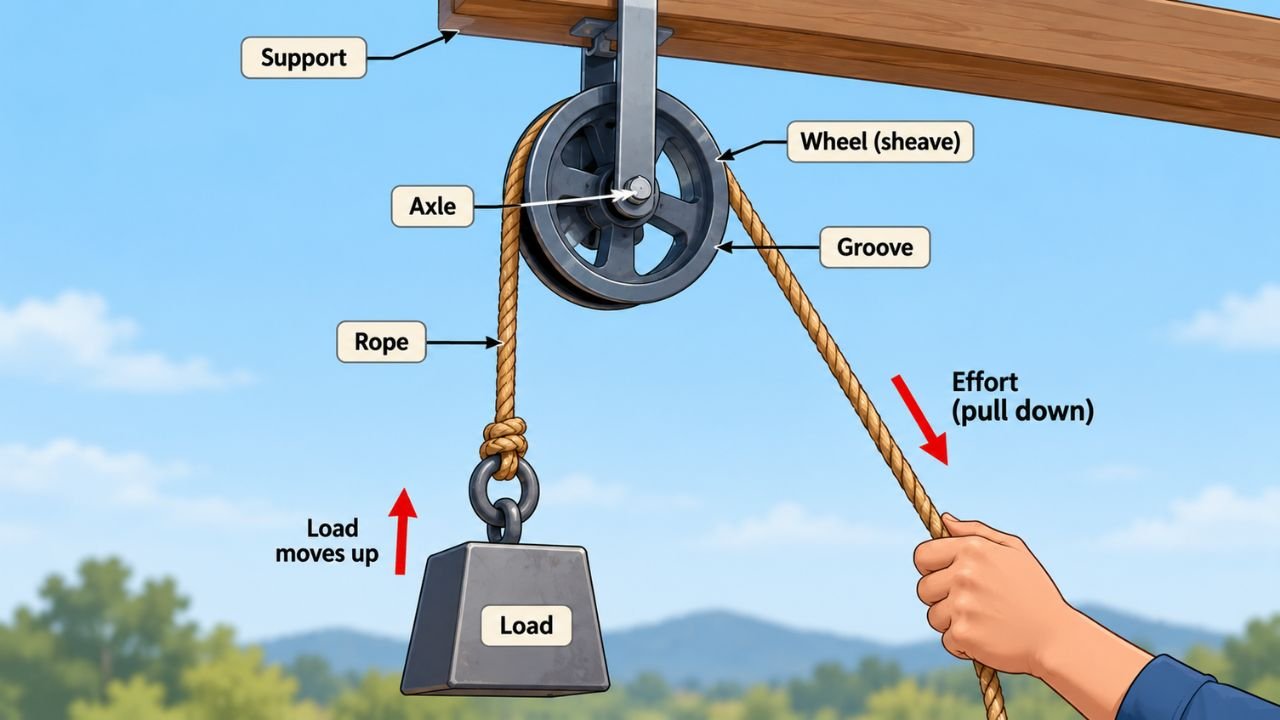
Parts of a Pulley
A basic pulley system has a few key parts that work together.
- Wheel: The wheel, also called the sheave, is the round part with a groove around its edge.
- Rope: The rope, cable, or belt sits in this groove.
- Axle: The axle is the rod through the center of the wheel that allows it to spin.
- Supporting Frame: The supporting frame holds the wheel and axle in place.
The rope or cable connects the load to the effort. The load is the object being lifted or moved, and the effort is the force you apply to the rope.
How Does a Pulley Work?
A pulley works by changing the direction of an applied force, which makes lifting tasks easier and more natural for the human body. When you pull down on one side of a rope that runs over a fixed pulley, the load on the other side moves upward.
This redirection is useful because pulling downward lets you use your body weight and a more comfortable pulling motion, rather than lifting straight up against gravity. The rope sits in the groove of the pulley wheel, which keeps it aligned and prevents it from slipping off during use.
Beyond simply changing direction, some pulley arrangements can also reduce the amount of force needed to lift a heavy load. This happens in a movable pulley, where the pulley itself moves along with the load instead of staying fixed in place.
Because the load is supported by two rope segments, the weight is shared between them, so each segment carries only half the load. This creates a mechanical advantage, which is the ratio of the load force to the effort force.
For a single fixed pulley, the mechanical advantage is 1, meaning the effort needed equals the weight of the load. In contrast, a single movable pulley has a mechanical advantage of 2, so you need only half the effort to lift the same load.
The trade off is that you must pull more rope to lift the load the same distance. If a movable pulley halves the effort, you must pull twice the length of rope to raise the load by a given amount.
This relationship between force and distance is a fundamental principle of simple machines and is what keeps the total work done the same in an ideal system.
Compound pulley systems, often called block and tackle, take this idea further by combining multiple fixed and movable pulleys. In these systems, the load is shared among several rope segments, so the effort you apply is divided even further.
For example, if four rope segments support the load, the mechanical advantage is 4, meaning you need only one-quarter of the load’s weight as effort.
The formula is straightforward: mechanical advantage equals load divided by effort, or in an ideal compound system, it equals the number of rope segments supporting the load.
Adding more pulleys increases the mechanical advantage and reduces the effort needed, but in real systems, friction between the rope and wheel, rope stretch, and the weight of the moving parts all reduce the actual advantage you gain.
Types of Pulleys
There are three main types of pulleys, each with a different arrangement and mechanical advantage.
1. Fixed Pulley
In a fixed pulley, the axle stays in one position. The wheel does not move with the load. This type of pulley changes the direction of the force but does not reduce the effort needed. The ideal mechanical advantage is 1, meaning the effort equals the load.
A common real-world use is a flagpole. You pull down on the rope, and the flag goes up.
2. Movable Pulley
In a movable pulley, the pulley moves with the load. One end of the rope is anchored to a fixed point, and the other end is pulled by you. Two rope segments support the load, so the ideal mechanical advantage is 2. This means you need only half the effort to lift the same load.
A common use is in construction hoists, where heavy materials are lifted with less effort.
3. Compound Pulley
A compound pulley combines fixed and movable pulleys in a system often called a block and tackle. This arrangement increases the number of rope segments supporting the load, which increases the mechanical advantage.
For example, a system with four rope segments supporting the load has an ideal mechanical advantage of 4. This means you need only one-quarter of the load weight as effort. However, you must pull four times the length of rope to lift the load the same distance.
Mechanical Advantage of a Pulley
Mechanical advantage (MA) tells you how much a pulley system multiplies your effort. It is calculated as:
Here, L is the load and E is the effort.
In an ideal pulley system, the mechanical advantage equals the number of rope segments that actually support the moving load. It is important to count only the segments pulling up on the load, not every visible rope section.
For example, in a single movable pulley, two rope segments support the load, so the ideal MA is 2. In a compound system with four supporting segments, the ideal MA is 4.
Solved Numerical Examples
Example 1: Fixed Pulley
A load weighing 150 N is lifted using a fixed pulley. Find the effort needed.
Given: L=150 N, n=1 (fixed pulley has one supporting segment).
Answer: An effort of 150 N is needed. A fixed pulley does not reduce effort; it only changes the direction of the force.
Example 2: Single Movable Pulley
A load weighing 200 N is lifted using an ideal movable pulley supported by two rope segments. Find the effort needed.
Given: L=200 N, n=2.
Answer: An effort of 100 N is required in the ideal case. If the load rises by 1 m, approximately 2 m of rope must be pulled.
Example 3: Compound Pulley System
A load weighing 400 N is lifted using a compound pulley system with four rope segments supporting the load. Find the effort needed and the distance of rope pulled if the load rises by 2 m.
Given: L=400 N, n=4, d_L=2 m.
Answer: An effort of 100 N is needed, and 8 m of rope must be pulled to lift the load 2 m.
Applications of Pulleys in Daily Life
Pulleys are used in many everyday situations.
A flagpole uses a fixed pulley to raise and lower a flag. A well uses a pulley to draw water up. Cranes use compound pulley systems to lift heavy construction materials.
Hoists use pulleys to lift engines or other heavy objects in workshops. Elevators use pulley systems to move the cab up and down.
Sailing equipment uses pulleys to adjust sails. Belt-drive machinery uses pulleys to transmit rotational motion between shafts, which is different from using a pulley to lift a load.
Advantages and Limitations
Pulleys make lifting easier by changing the direction of force or multiplying force. They are simple, reliable, and widely used.
However, real pulley systems have limitations. Friction between the rope and the wheel reduces efficiency. Rope can stretch over time.
Moving parts have weight that adds to the load. Maintenance is needed to keep the system working well. Also, when you gain mechanical advantage, you must pull a longer length of rope to lift the load the same distance.
Frequently Asked Questions
Q: What is a pulley in physics?
A pulley is a simple machine consisting of a wheel with a grooved rim that guides a rope, cable, or belt to change the direction of a force or reduce the effort needed to lift a load.
Q: What are the three main types of pulleys?
The three main types are fixed pulleys, movable pulleys, and compound pulleys (block and tackle).
Q: Does a fixed pulley reduce effort?
No. A fixed pulley changes the direction of the force but does not reduce the effort needed. Its ideal mechanical advantage is 1.
Q: What determines the mechanical advantage of a pulley system?
The mechanical advantage is determined by the number of rope segments that actually support the moving load.
Q: Why must more rope be pulled when less effort is needed?
Because gaining mechanical advantage means the effort moves a greater distance than the load. This trade-off is a fundamental principle of simple machines.
Key takeaways
- A pulley is a wheel with a grooved rim that guides a rope, cable, or belt.
- Fixed pulleys change the direction of force but do not reduce effort.
- Movable pulleys reduce effort by sharing the load between rope segments.
- Compound pulleys combine fixed and movable pulleys for greater mechanical advantage.
- Mechanical advantage equals the number of rope segments supporting the load in an ideal system.
- Gaining mechanical advantage means pulling more rope for the same load distance.
References
- BBC Bitesize, “How pulley and transmission systems work”: https://www.bbc.co.uk/bitesize/articles/zn2pdnb
- University of Wisconsin–Madison, “Pulleys – L.R. Ingersoll Wonders of Physics Museum”: https://www.physics.wisc.edu/ingersollmuseum/exhibits/mechanics/pulleys/
- CCEA, “Mechanisms Calculations: Part 1”: https://ccea.org.uk/downloads/docs/Support/Fact%20Files/2023/1.20%20Mechanisms%20Calculations:%20Part%201.pdf
- IEEE TechNav, “Pulleys”: https://technav.ieee.org/topic/pulleys/
- Wikipedia, “Pulley”: https://en.wikipedia.org/wiki/Pulley
- Western Washington University, “Ropes and Pulleys”: https://physics.wwu.edu/ropes-and-pulleys