Ice cubes float in a drink even though they are solid, which can seem strange at first. The answer is simple: ice floats because it is less dense than liquid water. This happens because of hydrogen bonds and the open structure that forms when water freezes.
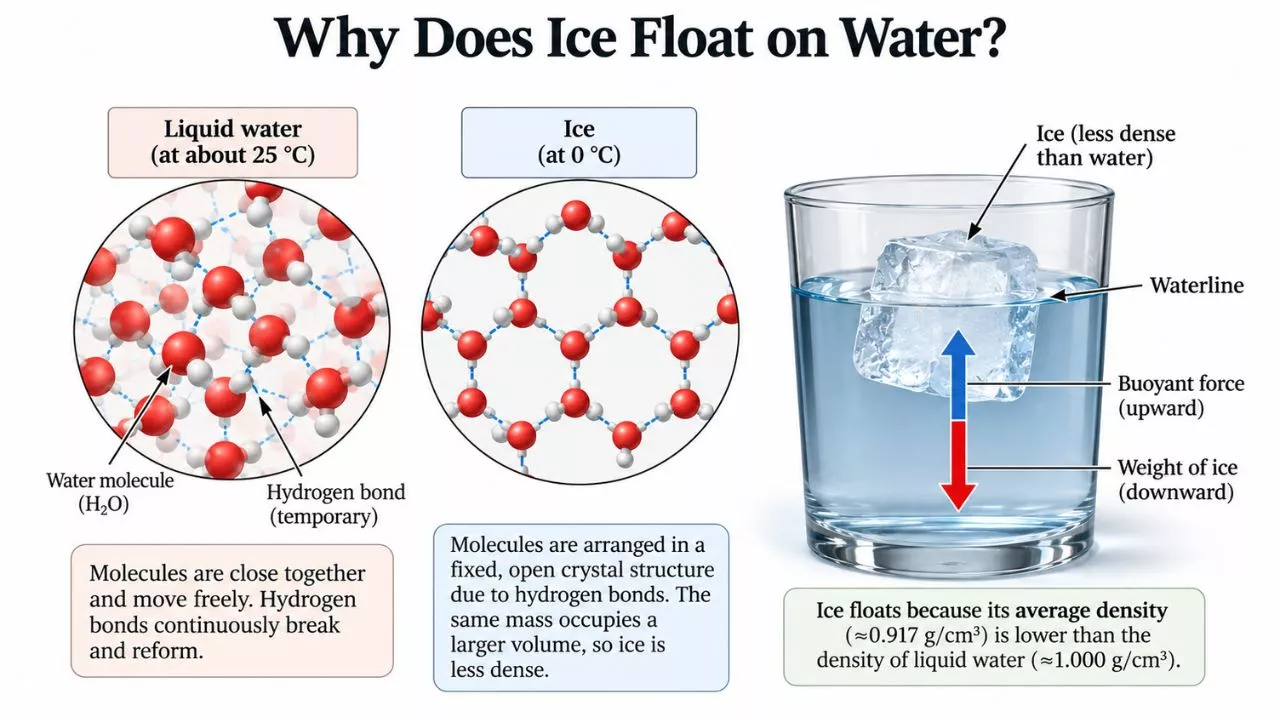
Why Does Ice Float on Water?
Ice floats on water because its density is lower than that of liquid water. Ordinary ice at 0°C has a density of about 0.917 g/cm³, while liquid water near 4°C has a density of about 1.000 g/cm³.
This difference comes from how water molecules arrange themselves when ice forms. In liquid water, molecules move around freely and hydrogen bonds constantly form and break.
When water freezes, the hydrogen bonds lock the molecules into a more ordered, open crystalline structure. This open structure has more space between molecules, so the same mass of ice takes up more volume than the same mass of liquid water, making ice less dense.
What is a water molecule?
A water molecule is made of one oxygen atom and two hydrogen atoms, giving it the chemical formula H₂O. The oxygen atom sits in the middle, with the two hydrogen atoms attached to it at an angle, giving the molecule a bent or V-shaped shape.
This bent shape matters because the oxygen atom pulls the shared electrons more strongly than the hydrogen atoms do. As a result, the oxygen end of the molecule becomes slightly negative, while the hydrogen ends become slightly positive. This uneven charge distribution makes the water molecule polar.
Because water molecules are polar, they are attracted to each other. The slightly positive hydrogen end of one molecule is attracted to the slightly negative oxygen end of another molecule. These attractions between neighbouring water molecules are called hydrogen bonds.
On thing to keep in mind is not to confuse hydrogen bonds with covalent bonds. The O–H covalent bonds hold the oxygen and hydrogen atoms together within a single water molecule.
Hydrogen bonds, on the other hand, are weaker attractions between different water molecules. These hydrogen bonds are what give water many of its unusual properties, including why ice is less dense than liquid water.
In liquid water, molecules move around constantly, and hydrogen bonds form and break over and over again. This allows molecules to slip past each other and pack relatively closely together.
As water cools, the hydrogen bonds become stronger and more stable because there is less thermal energy to break them apart. This sets the stage for the open crystal structure that forms when water freezes.
What Happens When Water Freezes?
When water freezes, something unusual happens compared to most other substances.
In liquid water, molecules move around freely, and hydrogen bonds constantly form and break. This allows the molecules to pack fairly closely together, giving liquid water a relatively high density.
As water cools and freezes, the hydrogen bonds lock the molecules into a more ordered crystalline arrangement. In ordinary ice, this arrangement is relatively open, with more space between molecules than in liquid water. The same mass of water therefore occupies a larger volume when it freezes, which reduces its density.
Water molecules themselves do not become larger when water freezes. Their arrangement changes. The open crystal structure is what causes the increase in volume and the decrease in density.
Why Is Ice Less Dense Than Liquid Water?
Density is a measure of how much mass is packed into a given volume. It is calculated using this formula:
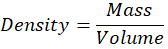
In ice, the open crystal structure allows a fixed mass of water to occupy more volume than the same mass of liquid water. Since density is mass divided by volume, a larger volume with the same mass means a lower density.
This is why ice is less dense than liquid water. The molecules are the same, but their arrangement is different, creating more empty space in the solid structure.
How Does Density Make Ice Float?
The molecular explanation explains why ice is less dense, but buoyancy explains how that density difference allows ice to float.
According to Archimedes’ principle, a floating object displaces water whose weight balances the object’s weight. In simple terms, an object will float if its average density is lower than the density of the liquid it is placed in.
Since ice has a lower density than liquid water, it floats. The buoyant force pushing up on the ice is greater than the weight of the ice itself, so the ice stays on the surface. Hydrogen bonding explains why ice is less dense, while buoyancy explains how that density difference allows it to float.
Why Is Water Most Dense at 4°C?
Water has an unusual behaviour when it comes to temperature and density.
From warmer temperatures down to about 4°C, liquid water generally contracts as it cools, which is what you would expect from most liquids. However, below about 4°C, the developing hydrogen-bonded structures cause water to expand slightly as it cools.
When water freezes under ordinary conditions, its volume increases by roughly 9%. This is why ice is less dense than liquid water and why it floats.
This unusual behaviour is directly linked to the hydrogen bonding in water. As water approaches freezing, molecules start to arrange themselves into ice-like structures, which creates more open space and lowers the density.
Why Is Floating Ice Important in Nature?
Floating ice plays an important role in nature, especially in lakes and ponds during winter.
Lakes and ponds generally freeze from the surface downward. Because ice is less dense than liquid water, it floats on top and forms a layer of ice on the surface.
This ice layer slows down heat exchange between the water below and the cold air above. As a result, liquid water can remain beneath the ice, which helps aquatic organisms like fish survive through the winter.
However, Not every water body freezes in exactly the same way. Depth, salinity, currents, and weather all affect how freezing happens.
A Simple Experiment: Observe Why Ice Floats
You can see this for yourself with a simple experiment.
Fill a transparent glass with water. Place an ice cube in the glass and observe how much of the ice remains above the waterline. You will notice that only a small part of the ice sticks out above the water, while most of it is below the surface. Record what happens as the ice melts.
This experiment demonstrates floating and melting. The molecular structure explanation accounts for the density difference that makes the ice float in the first place.
Key Takeaways
- Ice floats because its density is lower than that of liquid water.
- Hydrogen bonding contributes to the open crystalline structure of ordinary ice.
- Water expands on freezing under ordinary conditions.
- Liquid water has its maximum density at approximately 4°C.
- Floating ice helps insulate the liquid water beneath it, protecting aquatic life.
Frequently Asked Questions
Why does ice float instead of sinking?
Ice floats because it is less dense than liquid water. Its open crystal structure, formed by hydrogen bonds, creates more space between molecules, lowering its density.
Is ice lighter than water?
For the same volume, yes. Ice has less mass than the same volume of liquid water, which is why it is less dense and floats.
What is the density of ice?
Ordinary ice at 0°C has a density of approximately 0.917 g/cm³, while liquid water near 4°C has a density of about 1.000 g/cm³.
What role do hydrogen bonds play in ice?
Hydrogen bonds lock water molecules into an open, hexagonal crystal structure when water freezes. This open structure creates more space between molecules, making ice less dense than liquid water.
Why does water expand when it freezes?
As water cools toward freezing, hydrogen bonds force the molecules into an open crystalline arrangement. This arrangement takes up more space than the liquid arrangement, so water expands by about 9% when it freezes.
At what temperature is water most dense?
Liquid water has its maximum density at approximately 4°C. Below this temperature, water starts to expand slightly as hydrogen-bonded structures begin to form.
Why do lakes freeze from the top?
Because ice is less dense than liquid water, it floats on the surface. This means lakes freeze from the top down, with the ice layer insulating the water below.
Do all substances float when they freeze?
No. Ice floating is unusual, but not absolutely unique to water. Some other materials also have a less-dense solid phase, though water is the most well-known example.
Practice Questions with Answers
Multiple-choice questions
1. Why does ice float on water?
A. Ice is heavier than water
B. Ice is less dense than water
C. Ice is more dense than water
D. Ice has no mass
Answer: B. Ice is less dense than water, so it floats.
2. What is the approximate density of ice at 0°C?
A. 1.000 g/cm³ B. 0.917 g/cm³ C. 0.500 g/cm³ D. 2.000 g/cm³
Answer: B. 0.917 g/cm³.
3. At what temperature is liquid water most dense?
A. 0°C B. 4°C C. 10°C D. 100°C
Answer: B. 4°C.
4. What force explains why ice floats?
A. Gravity B. Buoyancy C. Friction D. Magnetism
Answer: B. Buoyancy, as explained by Archimedes’ principle.
5. What structure do water molecules form when they freeze?
A. Tightly packed linear structure
B. Open hexagonal crystal lattice
C. Random gas structure
D. Liquid structure
Answer: B. Open hexagonal crystal lattice, held by hydrogen bonds.
Short-answer questions
6. Explain why ice is less dense than liquid water.
Answer: When water freezes, hydrogen bonds lock the molecules into an open, hexagonal crystal structure. This creates more space between molecules, so the same mass of ice occupies more volume than the same mass of liquid water, lowering its density.
7. How does floating ice help aquatic life in winter?
Answer: Floating ice forms a layer on the surface of lakes and ponds, which slows heat exchange with the cold air. This allows liquid water to remain beneath the ice, helping fish and other aquatic organisms survive.
References
- https://www.britannica.com/science/Why-Does-Ice-Float-on-Water
- IAPWS, “FAQs About Water and Steam”: https://iapws.org/faqs/faq1
- OpenStax, “Archimedes’ Principle and Buoyancy”: https://openstax.org/books/university-physics-volume-1/pages/14-4-archimedes-principle-and-buoyancy
- https://www.sciencefocus.com/science/why-does-ice-float-on-water
- Britannica, “Buoyancy”: https://www.britannica.com/science/buoyancy