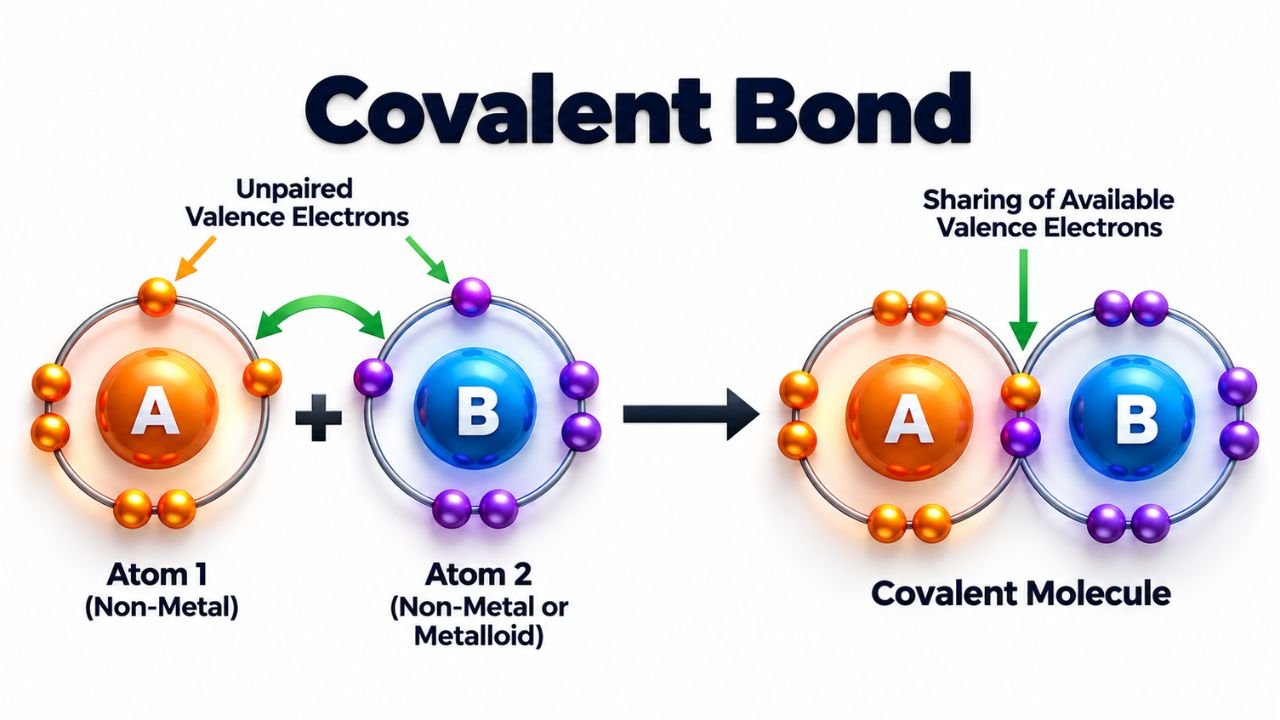
A covalent bond forms when two atoms share one or more pairs of electrons so that both can achieve a more stable outer electron arrangement.
Instead of one atom transferring electrons to another, as in an ionic bond, the atoms hold the shared electrons between them, creating a region of high electron density that attracts both nuclei.
Quick definition: A covalent bond is a chemical bond formed by the sharing of electron pairs between atoms.
What Is a Covalent Bond?
Atoms form bonds to become more stable. In many cases, this means reaching a full outer shell of electrons, often eight electrons, which is called the octet rule. Hydrogen is an exception because it is stable with only two electrons, called the duet rule.
A covalent bond forms when two atoms share a pair of valence electrons. Each atom contributes one electron to the pair, and the shared pair is attracted to the nuclei of both atoms. This mutual attraction holds the atoms together.
Example: Hydrogen molecule (H₂)
Each hydrogen atom has one valence electron. When two hydrogen atoms come together, they share their single electrons to form one covalent bond.
Diagram to include: Two H atoms, each with one dot, coming together to share a pair of electrons, written as H:H or H–H.
This shared pair gives each hydrogen atom access to two electrons, satisfying the duet rule and making the molecule stable.
How Does a Covalent Bond Form?
Covalent bonds form when two atoms with similar electronegativities come close enough that their valence electrons overlap and are shared. This sharing creates a region of electron density between the nuclei, which attracts both atoms and holds them together.
For a covalent bond to form, two conditions must be met:
- An orbital on one atom overlaps with an orbital on another atom.
- The single electrons in each orbital combine to form a shared electron pair.
When atoms have similar electronegativities, neither atom pulls much harder on the shared electrons. This means the electrons are shared fairly equally, which is what makes the bond covalent rather than ionic.
Step-by-Step Formation Process of a Covalent Bond
A covalent bond forms through a sequence of events: atoms with similar electronegativities approach each other, their orbitals overlap, attractive and repulsive forces balance, and energy is released, making the molecule more stable than the separate atoms. Let’s walk through each step in detail.
Step 1: Electronegativity Similarity
Covalent bonds happen between atoms with similar electronegativities, which is a measure of how strongly an atom pulls electrons toward itself.
When the difference in electronegativity is small, neither atom can completely steal an electron from the other, so they share electrons instead.
For example, two hydrogen atoms have the same electronegativity, so neither can pull the other’s electron away completely.
This is why they share their electrons rather than transferring them. If the electronegativity difference were large, like in NaCl, one atom would take the electron and an ionic bond would form instead.
Step 2: Orbital Overlap
As the two atoms get closer, their atomic orbitals begin to overlap. An orbital is the region around an atom where electrons are likely to be found. When two orbitals overlap, they create a shared region of high electron density right between the two positively charged nuclei.
This overlap is what allows the single electrons from each atom to pair up and be shared. The greater the overlap, the stronger the bond becomes, because more electron density is concentrated between the nuclei.
Step 3: Balancing Forces
Once the orbitals overlap, several forces act at the same time.
Attractive forces
- Each positively charged nucleus is attracted to the shared negative electron pair.
- This mutual attraction pulls the two atoms together and holds them in place.
Repulsive forces
- The two positively charged nuclei repel each other.
- The two electron clouds also repel each other because they are both negatively charged.
The balance point
At a certain distance between the atoms, the attractive forces and repulsive forces balance each other. This distance is called the bond length, and it is the point where the energy of the system is at its lowest.
If the atoms are too far apart, there is not enough overlap and the attraction is weak. If they are too close, the repulsion between nuclei and electron clouds becomes too strong. The bond forms at the distance where the net force is most favourable.
Step 4: Energy Release
As the orbitals overlap and the bond forms, energy is released, usually as heat. This happens because the combined molecule is more stable and lower in energy than the two separate atoms were before bonding.
The amount of energy released when a bond form is called the bond energy or bond enthalpy. The same amount of energy would be needed to break the bond and separate the atoms again.
For example, when two hydrogen atoms form H₂, a specific amount of energy is released. This released energy is what makes the H₂ molecule more stable than two separate H atoms.
Types of Covalent Bonds
Covalent bonds form when nonmetal atoms share pairs of valence electrons to achieve a stable electron configuration. They are classified in two main ways: by the number of shared electron pairs, and by how equally those electrons are shared.
Types of Covalent Bonds based on Number of Shared Electron Pairs.
The number of electron pairs shared between two atoms determines whether the bond is single, double, or triple.
1. Single Covalent Bond
A single covalent bond forms when two atoms share one pair of electrons. This single shared pair is always a sigma (σ) bond, formed by the direct, head-on overlap of atomic orbitals.
Key features:
- 1 shared electron pair.
- 1 sigma (σ) bond.
- Longest of the three types.
- Generally, the least reactive and easiest to break compared to double or triple bonds.
Examples:
- H₂ (H–H): each H shares one electron, forming one shared pair.
- H₂O (H–O–H): each O–H bond is a single covalent bond.
- CH₄ (methane): each C–H bond is a single covalent bond.
2. Double Covalent Bond
A double covalent bond forms when two atoms share two pairs of electrons. This consists of one sigma (σ) bond and one pi (π) bond. The sigma bond comes from direct overlap, while the pi bond comes from sideways overlap of p-orbitals.
Key features:
- 2 shared electron pairs.
- 1 sigma (σ) bond + 1 pi (π) bond.
- Shorter and stronger than a single bond.
- More reactive than a single bond because the pi bond is weaker and easier to break.
Examples:
- O₂ (O=O): two oxygen atoms share two pairs of electrons.
- CO₂ (O=C=O): each C=O bond is a double bond.
3. Triple Covalent Bond
A triple covalent bond forms when two atoms share three pairs of electrons. This consists of one sigma (σ) bond and two pi (π) bonds.
Key features:
- 3 shared electron pairs.
- 1 sigma (σ) bond + 2 pi (π) bonds.
- Shortest and strongest individual covalent bond type.
- Often more reactive overall because the pi bonds can be broken in reactions.
Example:
- N₂ (N≡N): two nitrogen atoms share three pairs of electrons.
Types of Covalent Bonds based on Electron Polarity.
Covalent bonds are also classified by how equally the electrons are shared between the two atoms.
1. Nonpolar Covalent Bond
A nonpolar covalent bond forms when electrons are shared equally between two atoms because the electronegativity difference is small or zero. A common guideline is that a difference of 0.4 or less is considered nonpolar.
Key features:
- Electrons shared equally or almost equally.
- No significant partial charges (no δ+ or δ−).
- Usually forms between identical atoms or atoms with very similar electronegativities.
Examples:
- Cl₂ (Cl–Cl): both atoms are chlorine, so electronegativity is identical.
- H₂ (H–H): both atoms are hydrogen, so electronegativity is identical.
- O₂ (O=O): both atoms are oxygen, so electronegativity is identical.
2. Polar Covalent Bond
A polar covalent bond forms when electrons are shared unequally due to a difference in electronegativity. A common guideline is that a difference of 0.5 or more is considered polar. This creates partial positive (δ+) and partial negative (δ−) poles on the molecule.
Key features:
- Electrons shared unequally.
- More electronegative atom becomes δ−.
- Less electronegative atom becomes δ+.
- Creates a bond dipole.
Example:
- H₂O (H–O–H): oxygen is more electronegative than hydrogen, so each O–H bond is polar, with O being δ− and H being δ+.
3. Coordinate (Dative) Covalent Bond
A coordinate covalent bond, also called a dative bond, forms when both shared electrons in the pair originate from a single atom rather than one from each bonding atom. After the bond forms, it behaves like a normal covalent bond.
Key features:
- Both electrons in the shared pair come from one atom (the donor).
- The other atom (the acceptor) provides an empty orbital.
- Once formed, it is indistinguishable from a regular covalent bond.
Example:
- NH₄⁺ (ammonium ion): nitrogen donates its lone pair to a proton (H⁺), forming a coordinate covalent bond. The nitrogen atom provides both electrons for this bond.
Lewis Dot Structures
A Lewis dot structure, also called an electron dot structure, shows how valence electrons are arranged in a molecule. It helps you see which atoms are bonded and where lone pairs are located.
Steps to draw a Lewis structure
- Count the total number of valence electrons for all atoms in the molecule.
- Choose the least electronegative atom as the central atom (hydrogen is never central).
- Connect the central atom to the surrounding atoms with single bonds.
- Distribute the remaining electrons as lone pairs to complete the octet of the outer atoms first.
- Place any leftover electrons on the central atom.
- If the central atom does not have an octet, form double or triple bonds by moving lone pairs from outer atoms.
Properties of Covalent Compounds
Covalent compounds show a range of properties depending on their structure and the forces between molecules.
1. Melting and boiling points
Simple molecular substances (like H₂O, CO₂, NH₃) usually have low melting and boiling points because the forces between molecules (intermolecular forces) are weak. However, larger molecules or those with strong intermolecular forces can have higher melting and boiling points.
Giant covalent networks, like diamond and silicon dioxide, have very high melting points because every atom is bonded to others in a large, continuous network. Breaking these bonds requires a lot of energy.
2. Electrical conductivity
Most simple covalent compounds do not conduct electricity because they have no free-moving charged particles. Exceptions include graphite, which conducts electricity due to delocalized electrons in its structure.
3. Solubility
Polar covalent substances tend to dissolve in polar solvents like water. Nonpolar covalent substances tend to dissolve in nonpolar solvents. This follows the “like dissolves like” rule, though it is a guideline, not an absolute law.
Real-Life Examples of Covalent Bonding
1. Water (H₂O)
Water is a polar covalent compound. The O–H bonds are polar, and the bent shape makes the molecule polar overall. This polarity gives water its unique properties, like high boiling point and ability to dissolve many substances.
2. Oxygen (O₂) and Nitrogen (N₂)
Both are diatomic molecules with covalent bonds. O₂ has a double bond, and N₂ has a triple bond. The triple bond in N₂ is very strong, which is why nitrogen gas is relatively unreactive.
3. Carbon dioxide (CO₂)
CO₂ has two polar C=O bonds, but the linear shape makes the molecule nonpolar overall. This is a classic example used to teach the difference between bond polarity and molecular polarity.
4. Methane (CH₄)
Methane is a simple organic molecule with four nonpolar C–H bonds arranged tetrahedrally around carbon. It is the simplest hydrocarbon and a good example of a nonpolar covalent compound.
5. Diamond, graphite, and silicon dioxide
These are giant covalent networks. In diamond, each carbon is bonded to four others in a rigid 3D network, making it extremely hard.
In graphite, carbon atoms are bonded in layers, allowing the layers to slide, which makes graphite soft and useful as a lubricant. Silicon dioxide (sand) has a network structure similar to diamond, giving it a high melting point.
Common Misconceptions
- Confusing a covalent bond with an intermolecular force. A covalent bond holds atoms together within a molecule. Intermolecular forces hold molecules together. They are different.
- Assuming all covalent bonds share electrons equally. Only nonpolar covalent bonds do. Polar covalent bonds share unequally.
- Assuming every covalent substance has a low melting point. Giant covalent networks like diamond have very high melting points.
- Assuming a molecule with polar bonds must be polar overall. CO₂ has polar bonds but is nonpolar due to its linear shape.
- Applying the octet rule without recognizing its limits. Hydrogen follows the duet rule, and some molecules like BF₃ have incomplete octets.
Practice Questions and MCQs
Multiple-choice questions
1. Which molecule has a triple covalent bond?
A. H₂ B. O₂ C. N₂ D. CO₂
Answer: C. N₂ has a triple bond with three shared electron pairs.
2. In HCl, which atom carries the partial negative charge?
A. H B. Cl C. Both D. Neither
Answer: B. Cl is more electronegative, so it pulls electrons closer and becomes δ−.
3. Which molecule is nonpolar despite having polar bonds?
A. H₂O B. NH₃ C. CO₂ D. HCl
Answer: C. CO₂ is linear and symmetrical, so the bond dipoles cancel.
4. What is the bond angle in CH₄?
A. 90° B. 104.5° C. 109.5° D. 120°
Answer: C. 109.5°, due to its tetrahedral shape.
5. Which of the following is a giant covalent structure?
A. H₂O B. CO₂ C. Diamond D. CH₄
Answer: C. Diamond has a continuous network of covalent bonds.
6. What type of bond forms between Na and Cl?
A. Nonpolar covalent B. Polar covalent C. Ionic D. Metallic
Answer: C. Ionic. Na transfers an electron to Cl, forming Na⁺ and Cl⁻.
7. Which molecule has a bent shape?
A. CO₂ B. H₂O C. CH₄ D. N₂
Answer: B. H₂O is bent due to two lone pairs on oxygen.
Short-answer questions
8. Draw the Lewis structure of NH₃ and identify the lone pair.
Answer: Nitrogen is central with three N–H single bonds and one lone pair on nitrogen. Total valence electrons = 8 (5 from N, 3 from H).
9. Explain why CO₂ is nonpolar even though it has polar bonds.
Answer: Each C=O bond is polar, but the molecule is linear and symmetrical. The two bond dipoles are equal and opposite, so they cancel, making the molecule nonpolar overall.
10. Compare bond length and bond strength for single, double, and triple bonds.
Answer: As bond order increases from single to double to triple, bond length decreases and bond strength increases. For example, C–C is longer and weaker than C=C, which is longer and weaker than C≡C.
Frequently Asked Questions
Q: What is a covalent bond in simple words?
A covalent bond is when two atoms share electrons so both can become more stable.
Q: Why do atoms form covalent bonds?
Atoms form covalent bonds to achieve a stable outer electron arrangement, often by completing their octet or duet.
Q: What is the difference between single, double, and triple bonds?
A single bond shares one electron pair, a double bond shares two, and a triple bond shares three. More shared pairs mean shorter and stronger bonds.
Q: What is the difference between polar and nonpolar covalent bonds?
In a nonpolar bond, electrons are shared equally. In a polar bond, one atom pulls the electrons closer, creating partial charges.
Q: Do covalent compounds conduct electricity?
Most simple covalent compounds do not conduct electricity because they lack free-moving charged particles. Graphite is an exception due to delocalized electrons.
Q: Is water a covalent compound?
Yes. Water has polar covalent O–H bonds, and the molecule is polar overall due to its bent shape.
Q: Are all covalent compounds gases or liquids?
No. Some are gases (CO₂, CH₄), some are liquids (H₂O), and some are solids with very high melting points (diamond, SiO₂).
Key Takeaways
- A covalent bond forms when two atoms share electron pairs.
- Single, double, and triple bonds share 1, 2, and 3 pairs respectively.
- Lewis dot structures show valence electrons and bonding.
- Polar bonds have unequal sharing; nonpolar bonds have equal sharing.
- Molecular shape depends on VSEPR theory and electron pair repulsion.
- Simple molecular covalent compounds usually have low melting points, while giant covalent networks have very high melting points.
- Covalent and ionic bonds differ in whether electrons are shared or transferred.
References and Further Reading
- NCERT Chemistry, Unit IV: Chemical Bonding and Molecular Structure: https://sathee.iitk.ac.in/sathee-icar/student-corner/ncert-books/class-11/nb-che-11/chemistry-11-chapter-4-chemical-bonding-and-moleuclar-structure/
- IUPAC Gold Book, “covalent bond” (C01384): https://old.goldbook.iupac.org/html/C/C01384.html
- OpenStax Chemistry: Atoms First 2e, “Molecular Structure and Polarity”: https://openstax.org/books/chemistry-atoms-first-2e/pages/4-6-molecular-structure-and-polarity
- OpenStax Chemistry: Atoms First 2e, Chapter 4 Summary: https://openstax.org/books/chemistry-atoms-first-2e/pages/4-summary
- OpenStax Chemistry, “Molecular Structure and Polarity”: https://openstax.org/books/chemistry/pages/7-6-molecular-structure-and-polarity