Green architecture is a design methodology that reduces a building’s environmental impact and resource consumption across its entire lifecycle, from material sourcing and construction to daily operation and eventual deconstruction
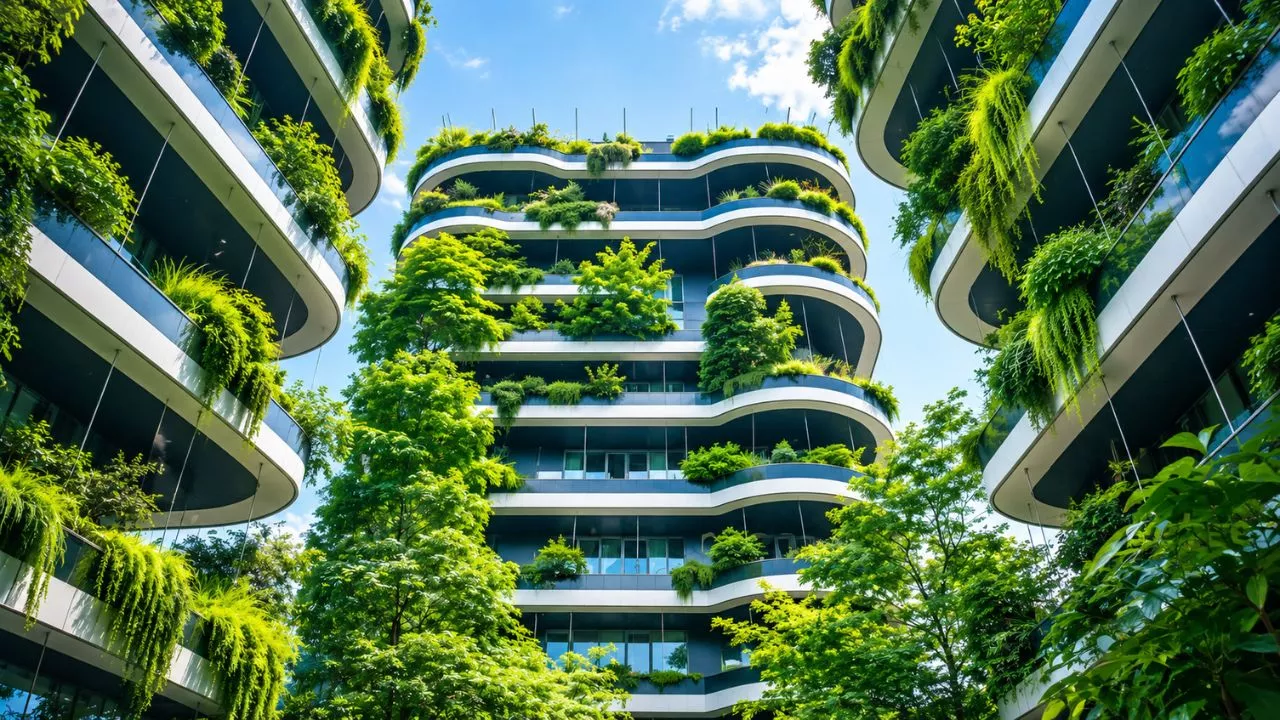
What is Green Architecture?
Green architecture is the practice of designing and constructing buildings that minimize their environmental impact across their entire lifecycle: from the materials used in construction, through their operational energy consumption, to how they perform at end of life.
A green building is not simply one that uses solar panels or has a planted roof; it is one where environmental responsibility has been integrated into every design decision from the earliest stage.
The term covers a wide spectrum of approaches. At one end are buildings targeting recognized certification standards such as LEED (Leadership in Energy and Environmental Design), BREEAM, or the Living Building Challenge.
At the other are projects that achieve environmental performance through vernacular wisdom: passive ventilation strategies derived from local building traditions, bamboo construction that sequesters carbon while growing, or rammed earth walls that regulate interior temperature without mechanical systems.
What the Architecture MasterPrize’s Green Architecture category recognizes is not a single approach but a shared commitment: that design excellence and environmental accountability are inseparable.
The best green buildings do not sacrifice spatial quality or architectural ambition for sustainability credentials. They showcase that the two reinforce each other.
Materials Used in Green Architecture
The materials used in green architecture are those that encourage good thermal performance, energy efficiency, water efficiency, resource management and save general construction costs.
The materials long-term effects on the environment are a key criterion for selection. The following list provides a guide to the types of materials which are suitable for green building.
The best materials are those which combine several of these features; materials like Accoya modified wood. This is sustainable, durable, manufacture is resource efficient, it is made from renewable material and it is non-toxic.
Materials like these are the mainstay of the most ecological builds and their use helps towards obtaining certification such as LEED.
1. Wood
Wood is used a lot in construction, as well as in-home furnishings. However, it should not be forgotten that it too needs to be sustainably collected and, if possible, reused. Wood can be used for the building structure, for walls, floors, and roof, but also for cladding, cornices, floors, and finishes.
2. Soil
Since ancient times the earth has been used to build houses mainly with the clay technique. In this case, we are dealing with compressed clay material to create a flat vertical surface.
By using Portland cement as a mixed binder like concrete, it is possible to arrive at a technique called “casting soil”. We can add that this technique is mostly used to satisfy specific requests on certain terrains.
Of course, we must not forget that earth is the oldest and most sustainable building material there is, since ancient times. Currently, raw earth is also used for finishes and to complete building envelopes.
3. Adobe
Adobe is one of the most used building materials both in the past and now. In summary, it is made up of earth mixed with water and sometimes with other substances, to allow greater resistance. To be precise, it is placed in the sun and dried.
Then it is given the desired shape by creating bricks which, together with mud and mortar, will form a wall.
4. Cob
When we talk about constructions in Cob, we are talking about clay and sand constructions, but also earth and sand. In fact, the earthen houses are composed of a mix of these materials that create a compound which will then be placed on a stone foundation, for example.
The boulders have the shape of the dough of bread and it is a type of construction present above all in the Marche and Abruzzo in the 60s.
5. Bamboo
Bamboo is a truly effective eco-sustainable material! In fact, it is used in many construction applications due to its resistance. Moreover, it is also and above all used to replace concrete.
They also call it “vegetable steel” for its great strength and flexibility. It is also used as a material to create internal flooring for buildings; in fact, bamboo is particularly durable and even resists scratches.
6. Recycled materials
Using recycled materials is important to give these raw materials a second life and reduce waste. In fact, unfortunately, today modern buildings produce enormous quantities of waste.
Some materials that can be recovered and reused are doors, wooden beams, pieces of concrete, pipes, frames, and windows. Using recycled materials means first of all reducing the environmental impact of buildings, which today is an essential duty.
7. Masonry
Masonry is a very old construction material that includes bricks and stones used for foundations, walkways, walls, floors, and other elements related to landscape decoration.
However, structural engineering has taken a more serious interest in this material only in recent times, but despite this, its use is having mostly positive results.
8. Straw bales
The buildings in straw bales are widespread mostly in the South American territory. Straw bales have very high insulating properties, are fire resistant, and easily recyclable. Often the straw bale is used as a filling for the wooden structure, but also as a load-bearing base to support the roof.
Principles of Green Architecture
As the world migrates towards a more sustainable future, architects are confronted with an important goal of design models that lessen the negative impacts on our environment due to construction. To make this a reality, the designs are guided by the principles of green architecture. Here are the principles.
1. Energy efficiency
The principles of green architecture incorporate various measures that encourage energy efficiency. It is done through designs that cut down energy consumption including the energy requirements for energy use and the exploitation of alternative and sustainable energy sources such as wind and solar.
For instance, green architecture takes care of natural air flow patterns and natural lighting to reduce the needs for heating, ventilating, and air conditioning; and artificial daytime lighting respectively.
The designs simply insist on reducing the lifetime costs of heating, lighting, air condition and other electric power usage requirements.
2. Water efficiency
Green architecture works with the inspiration of ecological surrounding to protect water quality and reduce water consumption or wastage. It is part of the sustainable principles in green construction which encourage the efficient use of water.
This green architecture principle makes certain that water is harvested, used, purified and re-used during the entire construction period.
At the same time, the architectural design ensures that in the entire life cycle of the building not only supports efficient water use but also preserves the quality of surrounding water systems and makes use of water recycling mechanisms.
3. Land use efficiency
Land use efficiency pertains to architectural designs that encourage suitable site development in terms of preservation of the surrounding environment and reuse of existing local materials.
It advocates for the incorporation of roof gardens, earth shelters and extensive landscaping around and throughout the building.
4. Low environmental impact and conservation of natural characteristics
Construction projects are proven to be responsible for more than 50% of environmental impacts and the destruction of natural systems. Construction projects also contribute to about 10% of the total global emissions every year.
One of the principles of green architecture is to therefore use green designs to lessen these environmental impacts.
Particularly, this green principle is all about preventing degradation of the site during construction, sprawl management, and the controlled use of resources as well as ensuring energy-efficient buildings lessen the overall impacts on the environment.
The design aids in the conservation of natural resources, improved water and air quality, and the protection of ecosystems and biodiversity.
5. Material efficiency
The proper management and use of materials in construction is also another huge concern. Proper construction techniques have to be employed and this is where green architecture comes in.
As such, material efficiency is one of the green architecture principles as it creates designs that inspire sustainable construction by optimizing the construction operations.
Material efficiency as a green architectural principle sees to it that the lifetime of the building enhances efficiency in terms of maintenance and operations.
Energy efficiency and resource conservation are the aspects incorporated in the designs to guarantee overall material efficiency.
6. Low maintenance costs
As stated earlier, the operational and construction costs associated with the conventional construction mechanisms prove quite high and are equally material demanding.
Green architectural design facilitates the use of materials and construction techniques that help in cutting back the operational and construction costs by more than half, all attributed to their cost-effectiveness.
This green architecture principle necessitates the need of using renewable plant products, recycled metal and recycled stone among other non-toxic products.
Renewable and reusable products ensure high performance while at the same time reducing the long-term maintenance costs.
7. Waste reduction
Green architecture advances the demand for reducing the wastage of water, energy, and materials during and even after construction.
On this basis, the green architectural design offer easier ways of reducing the amount of consumer product wastage generated by the building occupants through the integration of on-site solutions like compost bins and eco-friendly waste management system.
The design also takes care of water recycling and energy saving approaches in construction to reduce water and energy wastage respectively.
8. Use of renewable energy
Among the green architecture principles is the use of renewable energy. This principle ideally works to make renewable energy part of the architectural design or a highly recommended feature.
The use of wind power, solar energy and biogas are examples of renewable energy technologies which are often included in the green architecture designs.
The architects are keen at tailoring the designs based on the geographical locations to take full advantage of the available renewable energy.
For instance, green oriented architects design buildings to fully utilize the seasonal changes in the sun’s position and other regional renewable energy sources such as wind and biomass.
9. Indoor environmental quality
Indoor environmental quality is also part of the green architecture principles. The designing of a house or commercial building based on the green principles involves the features of comfortable interior space with an emphasis on natural temperature control, proper ventilation and the use of products that do not give off toxic compounds or gases. The purpose of the principle is to assure the quality of indoor environments.